Introduction: Selecting the Best Business Entity in India
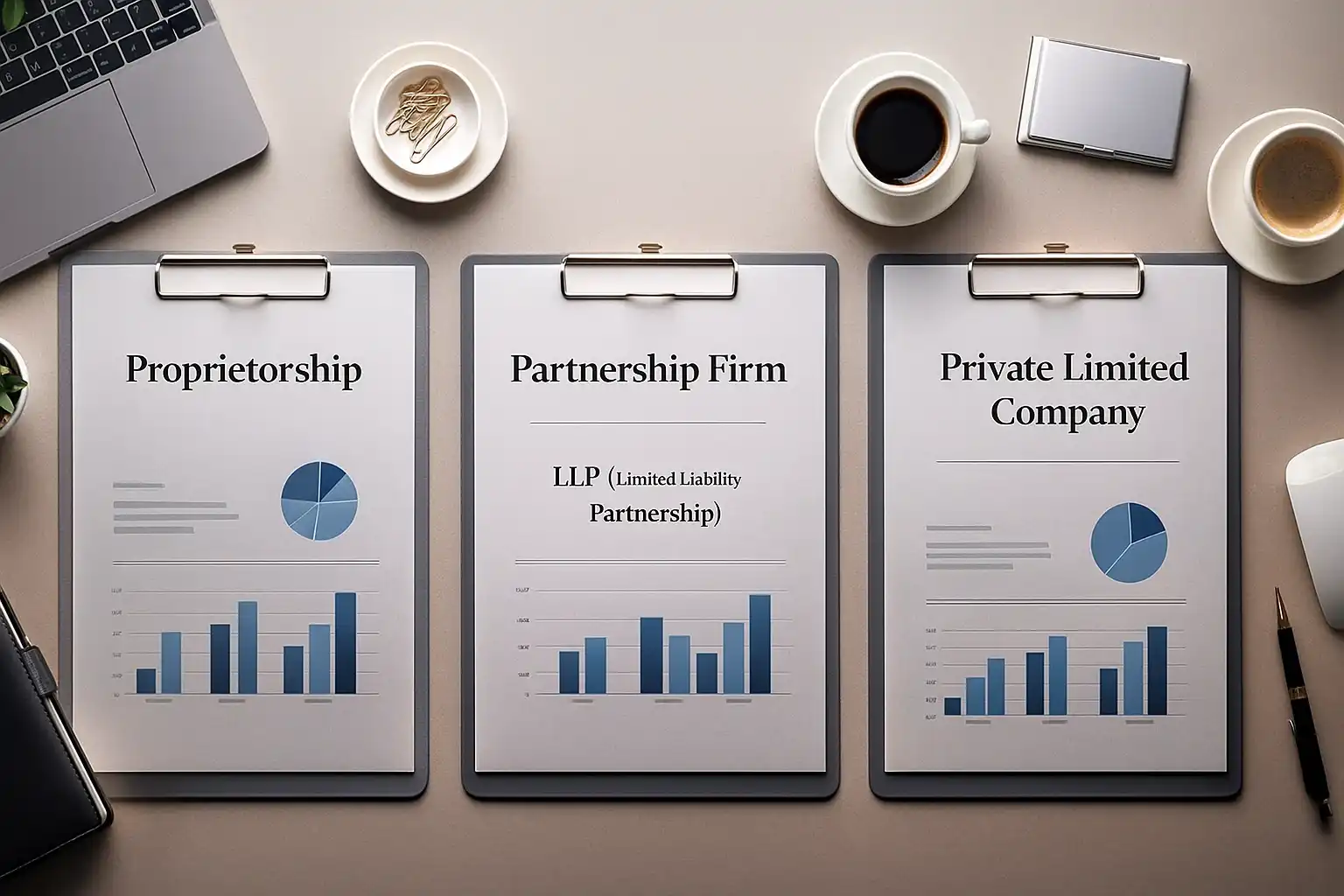
One of the most crucial decisions when starting a company is choosing the right business structure. It impacts taxation, liability, access to funding sources, compliance and long-term outlook for growth. The options varying in popularity, in India are – Proprietorship Partnership Firm LLP (Limited Liability Partnership) Private Limited Company -Every structure has its own usage, advantages and limitations. Knowing the differences helps entrepreneurs select a structure that fits their vision, tolerance for risk and business objectives.
The perfect type of business will largely depend on size, the number of founders, investment requirements and how much legal protection the owner needs. A well structured setup leads to seamless functioning, tax planning as well as credibility in the market.
Sole Proprietorship: Basic, Cost-Effective and Good for One-Person Shops
5) What about Sole Proprietorship? Kumparan is owned and run by a single person – really the easiest and cheapest model to get started with. The owner and the business are not legally distinct, so the owner is personally responsible for any profits, losses and debts.
Proprietorship is best for freelancers, small shop owners, home-based business and low risk businesses. With only a few mandatory compliancse guidelines to follow, entrepreneurs basically save both time and money and also get complete control over decisions. But there is one big drawback: total personal liability. The owner’s personal assets could be in jeopardy if the business has debt or legal troubles. It also does not have a credible standing with banks and investors; therefore, it’s not the most suitable for companies that want to scale.
Partnership Firm: Shared Efforts with Regardless Responsibility_boundmaintext
A Partnership Firm is formed when two or more people wish to start a venture collectively. It is regulated by the Indian Partnership Act, 1932 and is jointly formed through partnership deed which includes rights, roles, profit sharing & operations.
Partnerships provide shared decision making and pooled resources, so they can be a good choice for small businesses with co-founders or family members. As with a proprietorship, the compliance needs are low and it is easy to start the business.
Partnerships, however, have unlimited liability attached to them. Debts and the conduct of all the other partners are the personal liability of each partner. This is what makes partnerships a dangerous proposition with high-investment projects. Partnerships suffer from a lack of scalability as most investors dislike these entities in which there are no share-based ownership or formal corporate structure.
Limited Liability Partnership (LLP): Flexible Yet Protected by the Law
LLP is a contemporary corporate structure which is more simple or like partnership with limited liability feature of company. It is regulated by the LLP Act, 2008 and is a distinct legal entity in comparison to its partners. This ensures that partners’ personal assets are protected even if the business suffers losses or become embroiled in a court action.
LLPs have flexible structure capabilities for management. The partners can operate the business as they wish, with relatively little in the way of corporate formality. The compliance onus is moderate, and it is less cumbersome than a private limited company. For professional services businesses like CA practices, consultants or any other – LLP is often the best option.
However, there also are drawbacks to the LLP. Since they have no pillions, they cannot raise equity capital. LLPs Investors, venture capitalists and any big investors typically will not invest in LLPs. For companies looking to scale quickly or secure outside investment, LLP might not cut it. It is great for medium-risk companies that are looking for legal protection without onerous compliance.
a.) Private Limited Company: Most Scalable and Trustworthy Form of Structure
Most sought after structure for startups who seek to grow, build teams and raise funding- Private Limited Company. It exists as its own legal person and shareholders have limited liability. This model of the legal entity is regulated and under companies act 2013 must adhere to compliance, documentation process audit process and corporate governance task.
Private Ltd companies have good credibility with banks, customers and investors. They enable simple transfer of ownership, the joining of shareholders and issue of shares for financing. A majority of Indian startups, tech companies and fast-growing businesses operate under this structure as it allows long-term expansion, capital infusion and professional management.
A Private Limited Company has Several Benefits but it’s Costlier in Terms of Compliance as You have to file for Audits and Paper Realated work. Companies should also keep the proper accounts and ensure filings are made on time. Yet those labors do seem worth it when the aim is expansion, prominence and investor confidence.
Crucial Things to Consider Before Selecting a Business Structure
There are many things an entrepreneur needs to consider before choosing a final structure. Liability protection: This is what you need to safeguard for by choosing proprietorship and partnership where an owner is responsible for business risks personally and LLP /Pvtlimited are those that protect personal assets. Compliance capacity also matters. Proprietor (with a partner) is great for simplicity, if that’s what your going for. If it is the long-term growth that one is looking after, then LLP or Private Limited will serve as a better option.
Another deciding factor is funding. Only in exceptional cases do businesses organized as proprietorships or partnerships appeal to investors, since they cannot provide equity capital or corporate control. LLPs provide some respectability, but still have no access to share-based finance. Private Limited Companies shine in getting financed, bringing onboard investors and scaling. For businessmen with an ambition to expand, Private Ltd. is the way to go.
Takeaway: Which Is Best for Your Business?
There is no one structure that works for all businesses. The best answer depends on the entrepreneur’s goals and what the business is. Proprietorship is suited to simple, low-risk businesses. Partnership is fine for tiny teams that want shared responsibility but aren’t in it to grow quickly. BENEFITS OF LLP: Legal liability protection Provides flexibility Ideal for a service based or professional business. A Private Limited Company is the most preferred option for any startup that is looking to raise fundingand scale in the future.
The right structure is an investment in your business’s future. It’s what decides how your business will expand or manage risk or attract opportunity. With a clear idea and proper guidance you may lay the foundations for future success.