
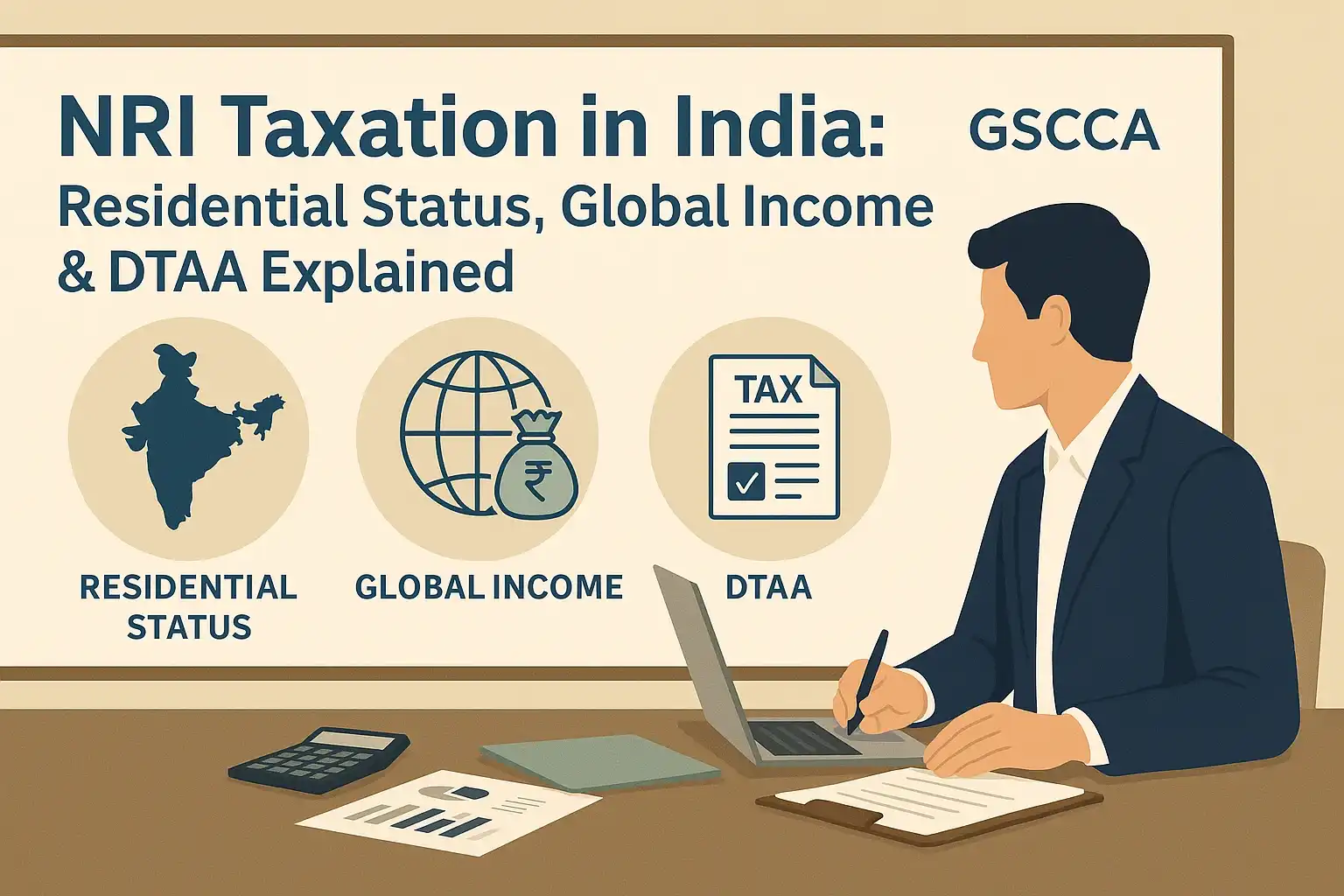
NRI Taxation in India: Residential Status, Global Income and DTAA Explained – GSCCA
Needless to say, it is important for a non-resident taxpayer in India who has established financial, family or business connections in India to understand the nature of NRI taxation. At GSCCA, we often help NRIs navigate complicated tax laws so they can remain on the right side of their obligations, while taking full advantage of what’s available. NRI taxation is massively built on three Focal points – Residential status and how to determine that, tax liability of global income, and The Double Taxation Avoidance Agreement (DTAA) with regard to certain countries. Understanding these terms assists NRIs in planning their income, investments and tax filings by being aware.
Understanding Residential Status for NRIs
The primary and most imperative step pertaining to NRI taxation is calculating the residential status of individual for that financial year. An individual is not automatically considered an NRI merely because he does not reside in India. Rather, the Income Tax Act refers to particular terms where physical presence in India is taken into account. A person is said to be resident in a fiscal year if they are physically present in India for 182 days or more during the year. They might also qualify as a resident if they spend at least 60 days in India that year and 365 days or more over the prior four years. If either of the two conditions are not satisfied, then the person could become Indian NRI for tax goal.
The law also comprises of a special provision for Indian nationals while in India and PIOs. The 60-day condition is exchanged for 182 days, and that empowers them even further. There are some extra rules also for people with large Indian incomes, involving a category known as “resident but not ordinarily resident.” This categorisation is significant because a resident, resident but not ordinarily resident and non -resident are tax differently. At GSCCA, we assist people in calculating their travel history and deciding how they should classify themselves prior to an estimate of your taxes.
Taxability of Global Income for NRIs
After checking which status applies to you, then we need to understand how the income tax works. A resident’s global income is taxable in India — or put another way, all income earned anywhere in the world must be disclosed and taxed here. But this does not exempt NRIs. Non-resident are taxed in India only on their India‐source income and they cannot claim tax credit under domestic law. Income that originates from overseas or is deposited directly in an overseas bank account isn’t taxable for an NRI under Indian Tax laws.
That’s a big deal in financial planning. For instance, income earned by an NRI as salary abroad or interest on foreign bank deposits or rental income from property overseas is not taxable in India. But if they make money from Indian sources — say, interest from NRO accounts, rental income from property in India, capital gains on shares or mutual funds, or income from a business/businesses operating here — all these are taxable. GSCCA assists to project their income properly and plan their investments into India so that the tax exposure is well managed yet fully compliant.
Taxability of Various Indian Income Sources for NRIs
NRI and taxable income Every kind of NRI (non-resident Indian) earning in India is taxed differently. Interest on NRE/FCNR accounts are fully exempt from tax, interest income on NRO is taxable. The Let out income of property in India is taxable after deduction an amount as standard expense and repairing. The treatment of capital gains can vary based on whether they are short-term or long-term; different tax rates apply. NRIs even receive gifts which can be subjected to tax if not received from close relatives. This information enables NRIs to take an informed decision when it comes to retaining or liquidating assets in India. GSCCA solves these challenges and helps clients analyze their capital asset-situation and select the most tax-effective path.
What is DTAA and how it benefits NRIs
Lots of NRIs are concerned about double taxation as they may have to pay taxes in both the countires – where they live and in India. This is where the DTAA becomes important. India has roll out DTAA agreements with over 90 nations. The objective of DTAA is to avoid double taxation on the same income. DTAA provides NRIs with the relief on tax either through exemption or tax credit. Like for example the interest income in India is taxed at a lower rate to residents of DTAA countries. However, if a tax was already paid on part of the income in India, it would receive credit for that amount when filing returns overseas.
Knowledge of DTAA provisions is essential to be aware when structuring Indian investments/ transactions in assets and how to optimise tax liabilities of global income. GSCCA assist NRIs to evaluate their treaty benefits, this include gathering of the documents i.e TRC and Form 10F Preparing in accordance with the correct tax rate there will be no extra tax withholding irrespective of payment.
NRIs Guideline Filling Income Tax Return
NRIs need to file their income tax in India, if the taxable income exceeds threshold of basic exemption limit. They may file a return even if their income is below the limit when they have capital gains or want to get refund of TDS deducted at source. Read: How to avoid breaking any rules while taking money outside The proper documentation – bank statements, property papers, TDS certificates and foreign residency proofs- ensure you don’t have a hick-up with compliance. Filing returns also enables NRIs to have a clear financial history for making investments, applying loans and in fulfilling regulatory needs. At GSCCA, we assist NRIs at every stage of the return filing process to file returns in a manner that is penalty-free and all eligible benefits are availed.
Conclusion
NRI taxation is simple if one has clear understanding of rules. Your residential status establishes where your journey, the global income rules dictate what is taxable, and DTAA safeguards NRIs from double taxation. If you are well organized with professional help of GSCCA, it is not at all difficult for NRIs to handle their Indian dues in a smooth and legal manner. In a world of travel and growing globalisation, the significance of keeping abreast with NRI tax laws has never been greater. Let’s call that today, and future interests fight onwards.