
Introduction
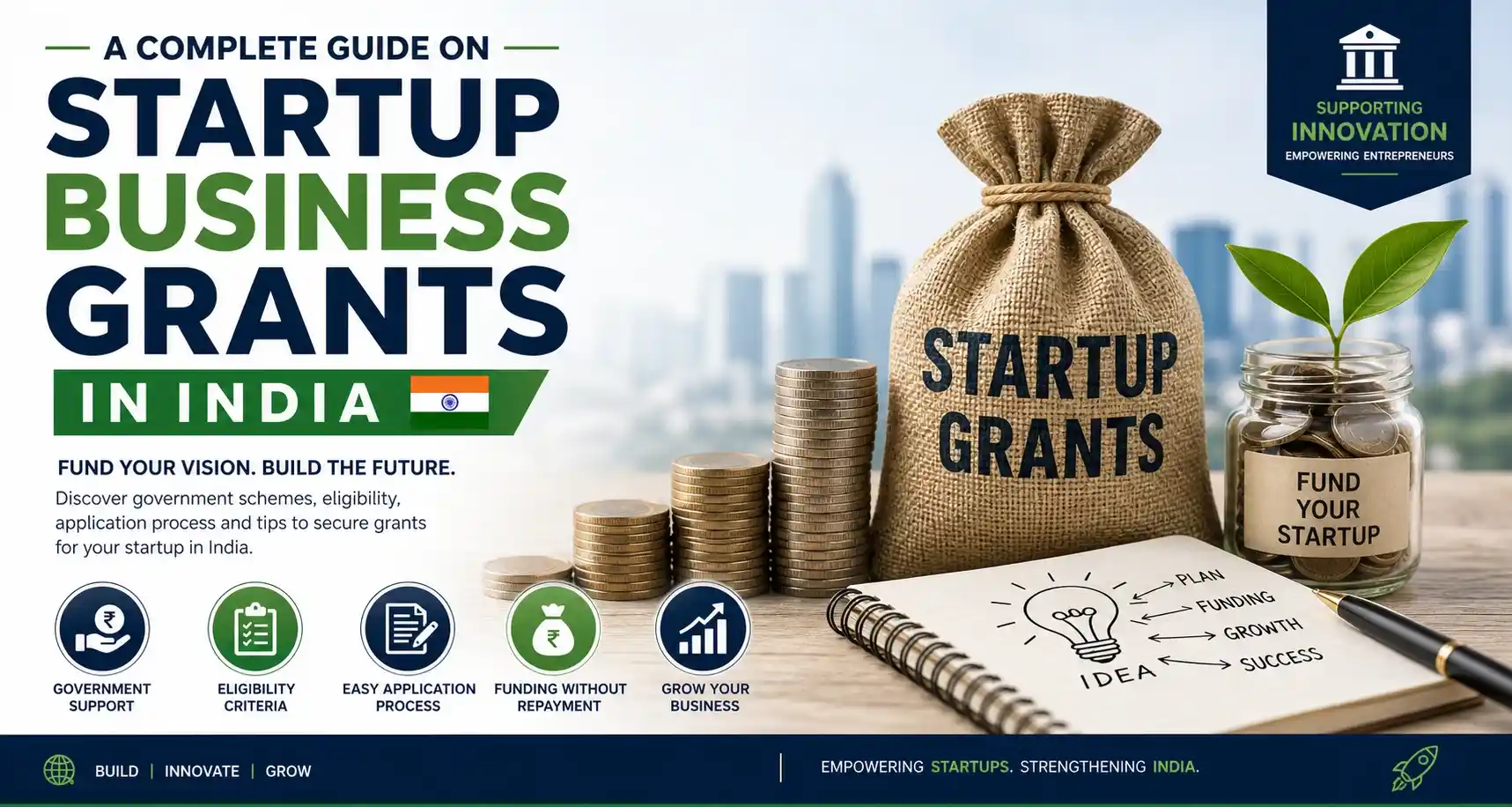
With the government initiatives to ensure both ease of doing business and also growing investor interest, starting a new thing in India has become easier than ever. But funding still remain the one of biggest challenges for startup. Though loans and investments are widely used, startup grants, can be an important harbor for many entrepreneurs which are not very well utilized. If you are a new business an entrepreneur out in the market to look for investment, startup business grants in India can greatly aid your processes with financial aid without worrying about repayment.
Grants are particularly useful for startups in their infancy, helping founders build on innovation without the stress of debt repayment or sacrificing equity.
What Are Startup Business Grants?
Startup business grants are free money offered to new businesses in the form of financial aids endowed by a government body, organization or institution. Grants indeed have the benefit of not having to be paid back, as opposed to loans, which makes it appealing for businesses.
These grants are typically provided to stimulate innovation, promote entrepreneurship, and boost certain sectors such as technology, agriculture, health care, and sustainability. India has also announced a number of initiatives that will create a better environment for startups and accelerate economic growth.
Startup Grants for New Ventures
Initial capital is one of the biggest problems for a lot of startups. Grants fill this area of insufficiency by providing money that can go into research, product development, marketing or operating costs.
The financial pressure is one of the huge benefits of startup business grants in India. With no repayment requirements, startups can scale their ideas more freely. It makes a business look more credible and helps with future investor attraction as well.
Government Initiatives Supporting Startups
Government of India has taken multiple initiatives to fund economy via startups / reforms in policy making. The Startup India program is designed to promote innovation and streamline the process of starting and operating a business.
Startup schemes provide startups ways to avail of multiple grant schemes, tax incentives as well as incubation assistance. These types of programming are aimed at stimulating entrepreneurship in both small and regional business precincts, even down to smaller cities and emerging markets.
Various startup grants available in India
Startup business grants in India – What are the different types available based on your Business Nature The grants are for research and development, tech startups and social enterprises.
Some grants are offered by state organizations, while others are funded by private bodies, incubators and international institutions. Every grant has its own set of eligibility, application process, and funding limitations.
Knowing what kind of grant fits your business model can help you get more approvals.
Eligibility Criteria for Startup Grants
Startup grants grant eligibility differs according to the scheme. Startup registration: By definition, startups are expected to be registered entities and in India they can be recognizedunder various Government initiatives like Startup India.
The selection process involves criteria like innovation, scalability, and potential impact. That said, some grants want to see a prototype or proof of concept (POC), others want you to be in a particular industry, and others are focused on social impact.
Without profession documentation & a clear business plan, you wont be able to successfully apply for startup business grants in India.
Startup Grant Application Process
Grants usually require a detailed application, with information including business plans, financial projections and project goals. Select groups of startups also have to pitch.
Read the guidelines carefully and fulfill all requirements before applying. Incomplete applications, or missing information can result in a rejection.
To have a strong application is to make it easy to get the fund.
Common Challenges in Getting Grants
Grants are very beneficial, but applying for them can be difficult. There are many applicants, and there is a thorough evaluation process. Startups, more often than not, either lack knowledge about the available mutual funds provided by VCs and how to apply, or they get bogged down in lengthy application processes for very narrow eligibility requirements.
This might affect future business planning as well since there may be delays in approval or disbursement of earlier funds. Yes, you have to be patient and persistent while applying for the startup business grants in India.
Role of Professional Guidance
Dealing with grants applications and compliance procedures — can be daunting, especially for first-time entrepreneurs. Companies like GSCCA, which render services on GST, company registration and financial advisory can further help startups with the documentation and compliance.
Although entrepreneurs can apply for grants, expert guidance in framing the application helps avoid common pitfalls. GSCCA is one which helps to lay the groundwork for businesses that indirectly boosts their fundability.
Tips for Increasing Approval Chances
A startup that has a good chance of getting a grant is one whose value proposition is clear and innovative. That takes a robust business plan with reasonable cash flow projections and a clear executable strategy.
Similarly, proving the socio-economic contribution that the business might have is also a big plus. The application is further fortified by the transparency, and accuracy of documentation.
It is strategic to have a clear understanding of the specific goals in each grant program and align your proposal accordingly.
Conclusion
Analyzing startup business grants in India is indeed a treasure trove to the entrepreneur aspiring to become scale their businesses. Grants support early-stage entrepreneurs with financial support without being in debt.
The process might sound complicated but with due diligence, documentation, and perseverance, it can succeed. Startups can get through the complexity of funding with an appropriate approach and support from seasoned firms like GSCCA whenever required, and focus on converting their ideas to businesses.