A lot of small business owners wait until they have to, either because a customer asks for a GST invoice or a supplier wants to see a GSTIN, before they register for GST.But choosing the right type of registration can make all the difference in getting your business up and running quickly.
The difference between these two routes is that eligible applicants can apply for GST registration under Rule 14A which is introduced in 2026 as a simplified application process for businesses that meet specific requirements. All other businesses can register for GST through the traditional route.What does this mean for your business?
GST Registration Under Rule 14A What is
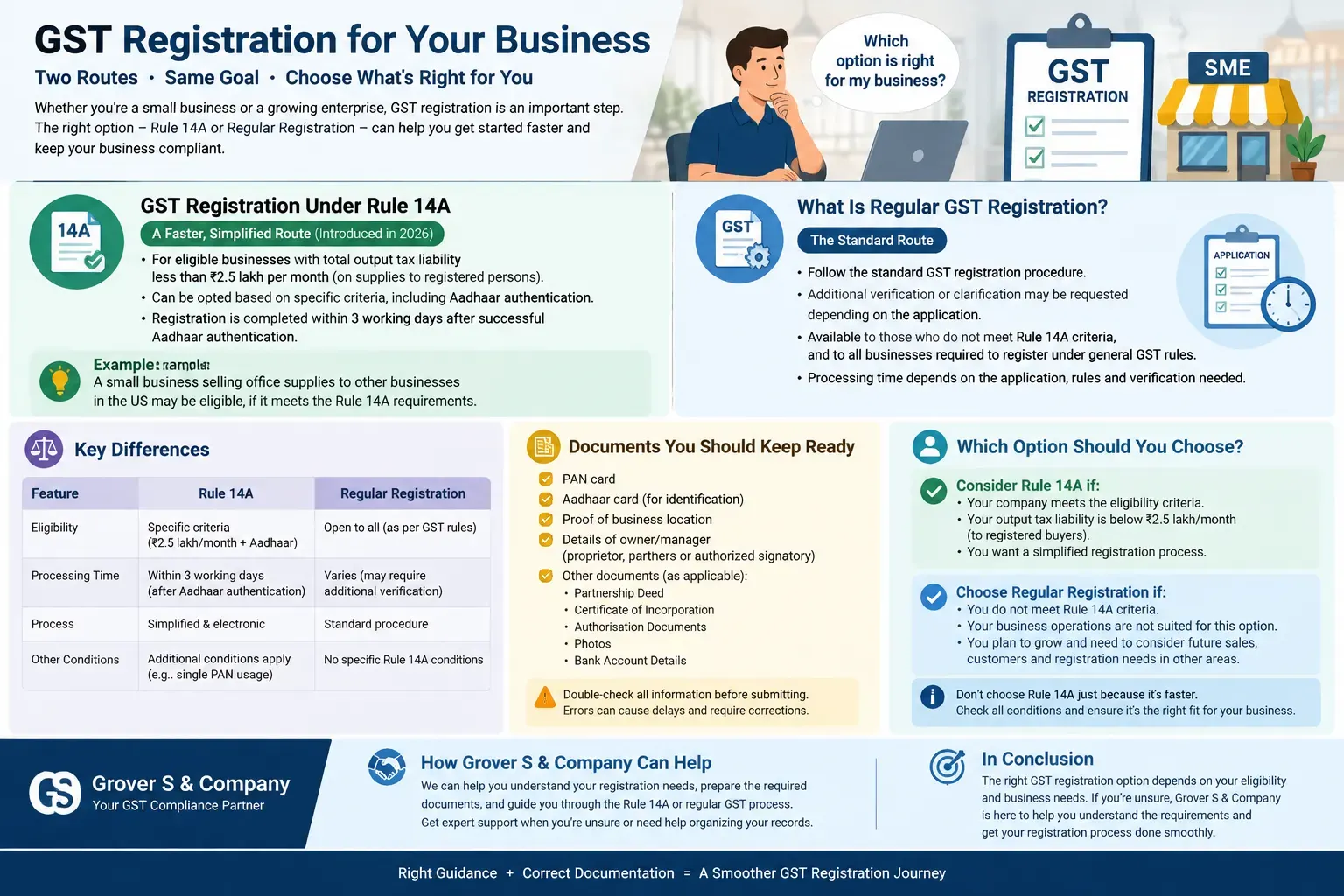
Rule 14A provides an alternative method of registration for eligible businesses whose total output tax liability on supplies to other registered persons is less than ₹2.5 lakh in a month.Rule 14A can be opted for based on certain criteria including Aadhaar authentication.
For example, let’s say you’re a small business who sells office supplies to other businesses that are registered in the US. If your company meets the requirements of the rule then Rule 14A may provide some benefit. What’s most important is that the eligibility for the rule is determined by how the relevant GST laws apply to your company and not merely by the size of your company.
The registration process is completed within three working days after successful Aadhaar authentication, per Rule 14A. The electronic completion of this process may be easier for some of the people who qualify for registration.
What Is Regular GST Registration?
Regular GST registration is completed by following the standard registration procedure. Depending on how the GST application is processed, additional verification or clarification may be requested.
This option is available to those applicants that have to register in accordance with the general GST rules, and also those that do not meet the criteria for Rule 14A. The processing time will depend on the rules applied to the application and what type of verification is needed; therefore, there can be no assumption made about the processing time of all regular applications.
Rule 14A vs Regular GST Registration: What Is the Difference?
The main difference is eligibility and the process available to the applicant.
The rule 14A provides for a maximum amount of output tax liability per month of ₹2.5 lakhs on the supply of goods or services to registered persons. The rule also prescribes some additional conditions. If you are an eligible applicant you will be issued your electronic registration certificate within 3 working days after the successful completion of the Aadhaar authentication process.
The registration is processed through normal channels and is not bound by Rule 14A eligibility requirements. Depending upon the facts of each case, a supplemental review of your application will likely be required.
There are two points to consider prior to selecting Rule 14A. First, a single PAN can only be used once to obtain an additional registration using Rule 14A within the same state or union territory. Second, if your company has multiple registrations, seek professional advice prior to selecting this option.
Documents You Should Keep Ready
Before you apply, make sure to gather all the necessary documents such as your PAN card, Aadhaar card for identification purposes, proof of where you operate your business and the relevant information about who owns or runs the company (i.e., proprietor, partners, or authorized signatory).
Depending on how you have structured your business, there are other documents that you might need to submit as well (such as a Partnership Deed, Certificate of Incorporation, Authorisation Documents, Photos and Bank Account Details). However, as these requirements can change over time, we recommend checking the most up-to-date guidance from the GST portal prior to completing the application process.
A single error like typing the wrong address or having different information on your company’s profile could cause issues that were avoidable. Most likely, it will be easier to check all of the information before submitting, rather than trying to fix it after.
Which Option Should You Choose?
The Rule 14A conditions are met by your company and the output tax owed on sales to registered buyers is below the specified threshold then you might consider using the option described. This method could also assist those businesses that qualify for the simplified registration procedure.
However, if you do not satisfy the criteria for a regular GST registration and/or your business operations are not suited for this option then the best alternative is a standard GST registration. Businesses that intend on growing will also need to think about how much they expect to sell, who their customers will be and what the registration requirements will be in other areas.
Make sure you don’t select Rule 14A simply because you think it will be faster. Look at each condition and determine if the option is right for your company.
How Grover S & Company Can Help
The process of registering for GST is much more than simply completing an online application. It is important to know what provisions of the GST act will affect your business and to ensure that all of the data submitted is correct.
The Grover S & Company can provide assistance to determine your registration needs, create the required documentation, and assist with understanding the registration process under Rule 14A or for regular GST. Professional assistance may be helpful when you are uncertain of whether you qualify for registration, or if you need assistance organizing your company’s records.
The goal is to provide guidance for completing the steps successfully so that you can concentrate on managing your company, and not waste valuable time working through documentation.
Conclusion
The choice between applying through Rule 14A and registering as a standard GST applicant will depend upon your eligibility to apply for either type of registration and the needs of your business. Rule 14A provides an easier way to apply for registration if you meet the requirements, however, if you are required to register as a standard GST applicant because of the rules that apply to you then that is the right path to take.
If you do not know what kind of application applies to your company, Grover S & Company will assist in understanding the requirements and getting ready for the registration process.