
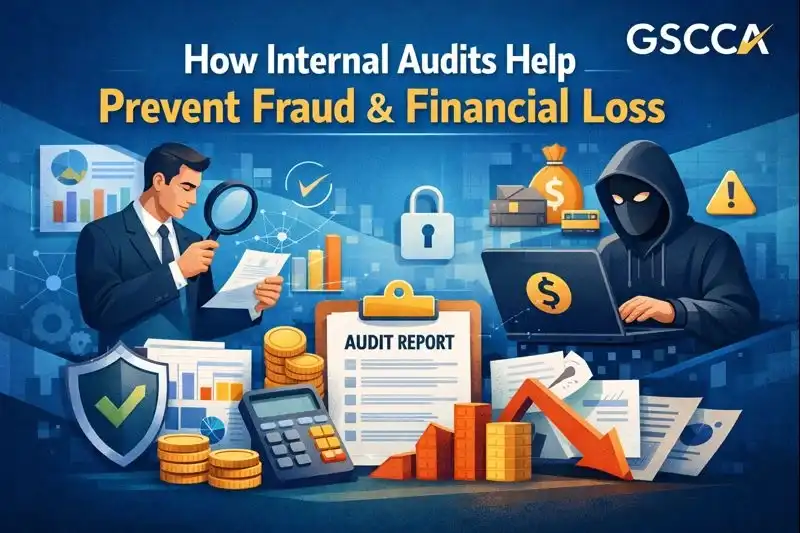
The Role of Internal Audits in the Prevention of Fraud and Loss in Your Business
In this complicated business environment, there is higher risk of fraud, mismanagement and financial loss that compels companies to take precautionary measures. As businesses scale, the number of transactions goes up, processes become more complex and the opportunity for mistakes or wrongdoing increases. That’s where internal audits come in as a vital means of early detection and ensuring that businesses are financially sound and in compliance. For companies such as GSCCA, internal auditing is not merely a compliance exercise – it’s about preserving value, reinforcing systems and building durable trust.
The Role of Internal Audits Explained
Internal audits are objective assessments of an organization’s financial processes, internal controls and risk management solutions. Internal audit is not a one-time only activity like statutory audits, but based on continuous and preventive basis. It’s to determine if a process is working well and if numbers are correct, they want to verify that.
As a part of internal audit, accounting records, operational processes and authorization mechanisms are reviewed, as well as compliance contexts. By doing so, auditors are able to detect vulnerabilities which might allow for fraudulent activity or misleading financial statements for a company. Internal auditing at GSCCA is aimed to help businesses to have visibility and control over their financial management.
Early Detection of Fraudulent Activities
The most important advantage of internal audits is the early uncovering of fraud. Fraud often begins small, with unapproved charges, records fudging or misuse of company money. Without monitoring, these actions can lead to significant monetary losses and damages to an institution’s reputation.
Internal audits can reveal odd regularities, variations or divergences from normal routines. Regular audit checks create disincentives for frauds in the sense that employees and management know systems are being audited. This is proactive risk management and it ’develops a climate of accountability and ethics within the organization.
Weak internal controls are among the leading causes of financial fraud and operational losses. It includes but is not limited to approval hierarchies, segregation of duties, and access controls over financial data. When auditors come unstuck with such mechanisms, he or she makes recommendations to strengthen them. Strong internal controls prevent unauthorized transactions and errors. GSCCA focuses on the development of an internal audit framework that not only identifies weaknesses but also offers the best practices that organizations of a certain size and industry should implement. Financial fraud is not the only way businesses lose money. A significant number of losses stem from basic human errors, inefficient processes, and the failure to maintain proper documentation. Internal audits assess transaction accuracy, reconciliation processes, and compliance with accounting standards. Identifying errors before they escalate into a significant loss enables businesses to correct their financial books. The same approach helps companies to identify unnecessary steps and streamline their processes. Streamlined processes help businesses cut costs and optimize their financial performance. Companies operate under a plethora of laws and accounting standards. Failure to comply with the laws can be costly not just in the form of penalties but also through the loss of credibility in the eyes of customers. Internal audit frameworks help organizations to achieve not just compliance but also understand the latest trends in the tax and accounting spaces. GSCCA guides businesses to be better prepared so that they could update internal processes every time regulatory authorities introduce a new measure.
Internal audit presentations offer insights into operational risk and financial health. These kinds of insights allow business leaders to be pro-active, not re-active. Working toward “strategic value” GSCCA’s approach to internal auditing is about more than finding problems.
Building Stakeholder and Investor Confidence
Investors and stockholders Lenders Business owners WANT REASSURANCE THAT a business is well run Financially strong. Routine internal audits are a sign of transparency and best governance.
When stakeholders understand an organization has strong internal audit processes in place, it can also boost their confidence. This may increase financing opportunities, contribute to corporate reputation and help the company grow in the long-run. GSCCA supports corporations to develop audit practices that enhance stakeholder confidence and corporate integrity.
Preventing Long-Term Financial Damage
It is also the case that, in many cases, fraud and managerial misconduct do long-term harm that exceeds dollar losses. The financial cost of legal fees, loss of business and erosion of client confidence can bear heavily on the sustainability of a practice. Internal audits are a kind of loose preventive shield that can help spot risks before they become crises.
A proactive audit methodology helps businesses to find and fix flaws early. Not only is the risk of potential loss averted but also business continuity, and robustness, in volatile market circumstances is achieved.
Conclusion
Internal audits are an important resource to avoid fraud and reduce monetary losses. They are early warning signals, they enhance internal controls, achieve compliance and enhance financial discipline. Even for the smaller and larger organizations, an internal audit should not be considered as a cost but rather as a long term security and to secure longevity of success.
We believe that our aim for quality audits is an all-encompassing goal that goes beyond mere compliance. Through assisting companies to identify and mitigate risk, enhance controls and protect financial integrity, GSCCA helps clients build solid, transparent business entities that are sustainable.