Understanding Inventory Accounting in eCommerce
Inventory accounting is the methodology for maintaining and valuing the goods a company sells. In the case of eCommerce, inventory means products held in warehouses, fulfillment centers, or even on the way somewhere.
ECommerce sellers, unlike traditional businesses, are not limited to just one platform (your own store) but instead are spread across multiple platforms (marketplaces + websites). This complicates inventory tracking, as all stock levels need to be updated immediately across every respective channel.
Inventory accounting is vital for proper preparation of financial statements and for handling Income tax & returns online as the actual profits in financial statements must reflect the profits in actual business.
Why It Matters to Online Business and Inventory Accounting
Revenue and expenses are directly impacted by inventory. If it is unrelated, it may result in overstocking and stockouts or false financial reporting. Such problems affect customer experience and business bottom line.
In the calculation of profit the COGS (cost of goods sold) is the result of the proper accounting of stock. This also helps avoid costly mistakes while filing Income tax & returns india as well as ensures that taxes are computed correctly.
Most business men rely on the Best chartered accountant near me for his/her incredible work of maintaining an accurate inventory record that corresponds to financial reporting purposes.
Inventory Valuation Methods
To accurately account for their inventory, companies must choose an inventory valuation method. The methods that are used most frequently in eCommerce are FIFO, LIFO, and Weighted Average Cost.
FIFO (first-in, first-out) is also a popular method for eCommerce, as it reflects the movement and shelf life of products, thus, the oldest stock will be sold first. This method is applied to a wide range of similar-looking products, mainly items sold in large volumes; in this case, the cost is calculated based on the weighted average of stock items.
Now, choosing the method has consequences on profit calculation and tax liability, therefore, it is always advisable to consult a chartered accountant so that you make the right call.
Tracking Inventory Across Multiple Channels
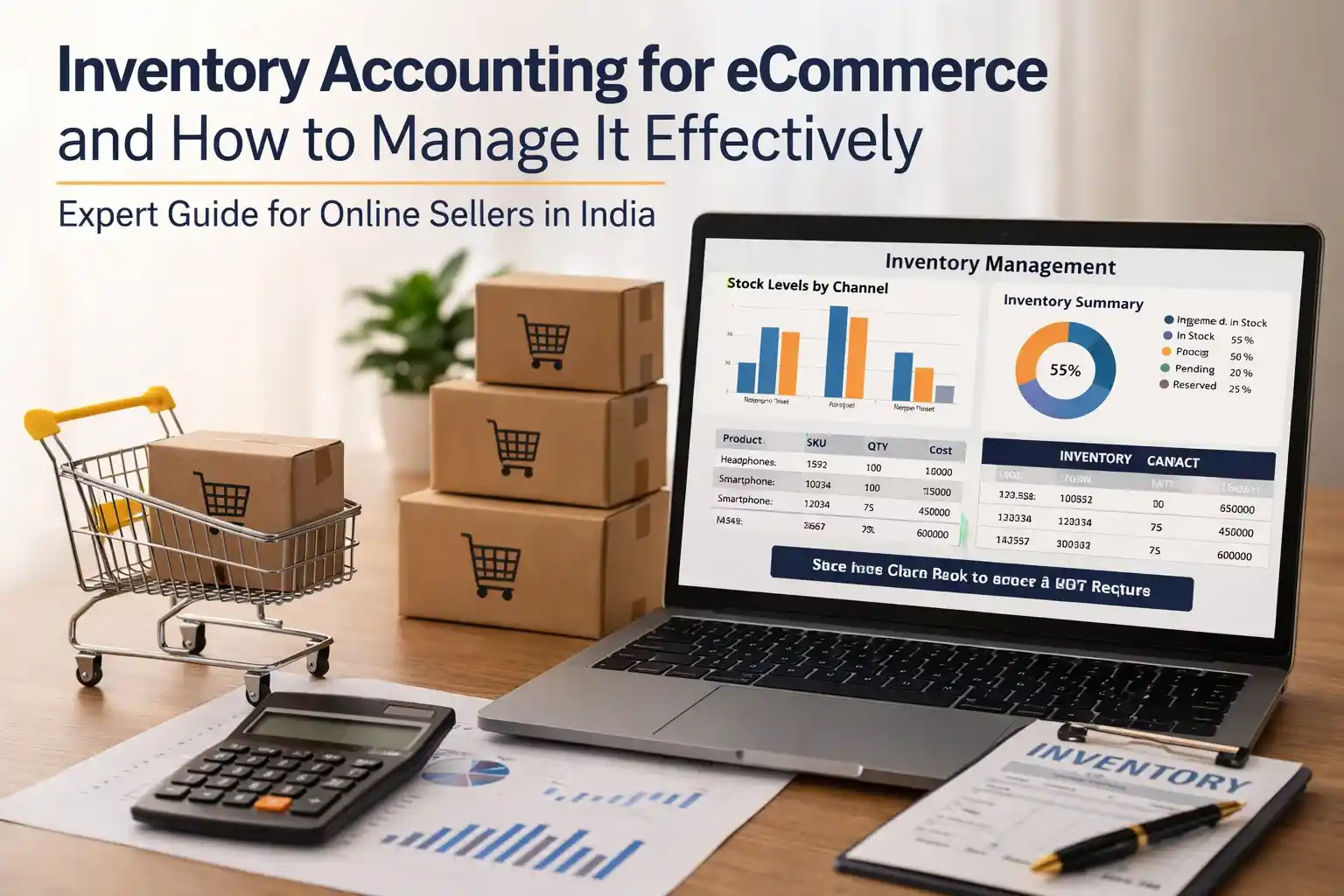
Many ECommerce businesses will sell their products on different platforms, which results in additional complexity. Real-time synchronizing of stock levels across all channels with the help of a centralized inventory management system.
You may sell more of a good than you actually have if you are not tracking inventory properly or discover discrepancies in your stock. This may result in order cancellation, bad customer experience, and loss of revenue.
A Chartered Accountant near me with professional guidance can get the accounting systems synced with inventory tools to prevent data mismatch across the platforms.
Cost of Goods Sold (COGS) Management
Cost of Goods Sold (COGS) is among the most vital elements towards accounting for inventory. It consists of the cost of buying or producing goods that are sold within a given period.
Calculating COGS manually is necessary to identify gross profit correctly. Mistakes in the valuation of inventory impact COGS and, thus, the business financial results.
For businesses managing a higher number of transactions, professional assistance through Income tax & returns online services can ensure proper COGS calculation reflected in the financial statements.
Handling Returns and Damaged Goods
One of the most common elements of eCommerce operations is returns. It is essential to ensure proper accounting for returned and/or damaged goods to maintain accurate inventory records.
Returns need to be restocked as new or disposed of as unsellable if they are damaged. Not properly accounting for returns can skew the value of what is in inventory and financial reports.
The Best chartered accountant near me helps the business in managing returns in an effective manner so that there is no place for tax and compliance to complain.
Significance Of Automation In Inventory Accounting
Tracking inventory manually leaves room for error, especially in more high-volume eCommerce businesses. Accounting and inventory management is software that maintains a high level of accuracy and efficiency.
While manual invoicing has its pros and a few potential cons too, the good thing about automation is that you can track everything in real time, reduce human error and directly integrate with financial systems. This also makes it much easier to reconcile stocks, run reports and calculate taxes.
Automation tools are used together with professional knowledge of a chartered accountant to get better control over financial operations of a business.
Introduction to GST and Inventory Accounting in eCOMMERCE
Now, under GST, inventory accounting itself is the activity that determines your tax liability. Under GST laws, businesses will be required to keep track of their purchases, sales, and movement of stock through accounting records.
ITC cannot be availed for any in-valid purchases hence documentation at every step is crucial. Your GST returns could mismatch and result in penalties if you have bad inventory records
And this is where GSCCA and the like come in. GSCCA is a professional firm engaged in providing GST and company registration services to businesses while ensuring accurate recording of their inventories and compliance with GST. They have deep knowledge in handling eCommerce sellers’ intricate accounting needs.
What is the best practice for accounting for inventory?
Proper inventory accounting requires consistency is record-keeping. Conducting regular stock audits may bring forth discrepancies and ensure accuracy. As well as this, businesses should create transparent systems for the movement of stock, returns, or write-offs.
Maintaining proper records, and using proper and dependable accounting systems, can lead to greater transparency, and easier reporting when it comes to finances. Chartered Accounts near me will bring in professional support in a way that these practices are applied in the right fashion and also are utilized consistently.
Conclusion
Inventory accounting is one of the most important aspects of managing an eCommerce business. This will not only take care of tracking the stock, calculation of profits but will also assist in maintaining compliance with tax laws.
Whether it is selecting the appropriate valuation method, return management, or automation, there is a multitude of inventory accounting-related tasks that need to be handled carefully. Inventory management mistakes can result in a financial misrepresentation and regulatory compliance problem.
If you are a business looking to simplify your operations, you can always opt for the Best chartered accountant near me, and those associated with Income tax & returns india in order to guide you. If managed properly, inventory accounting can be a potent agent for increased efficiency, profitability, and sustainable business growth.