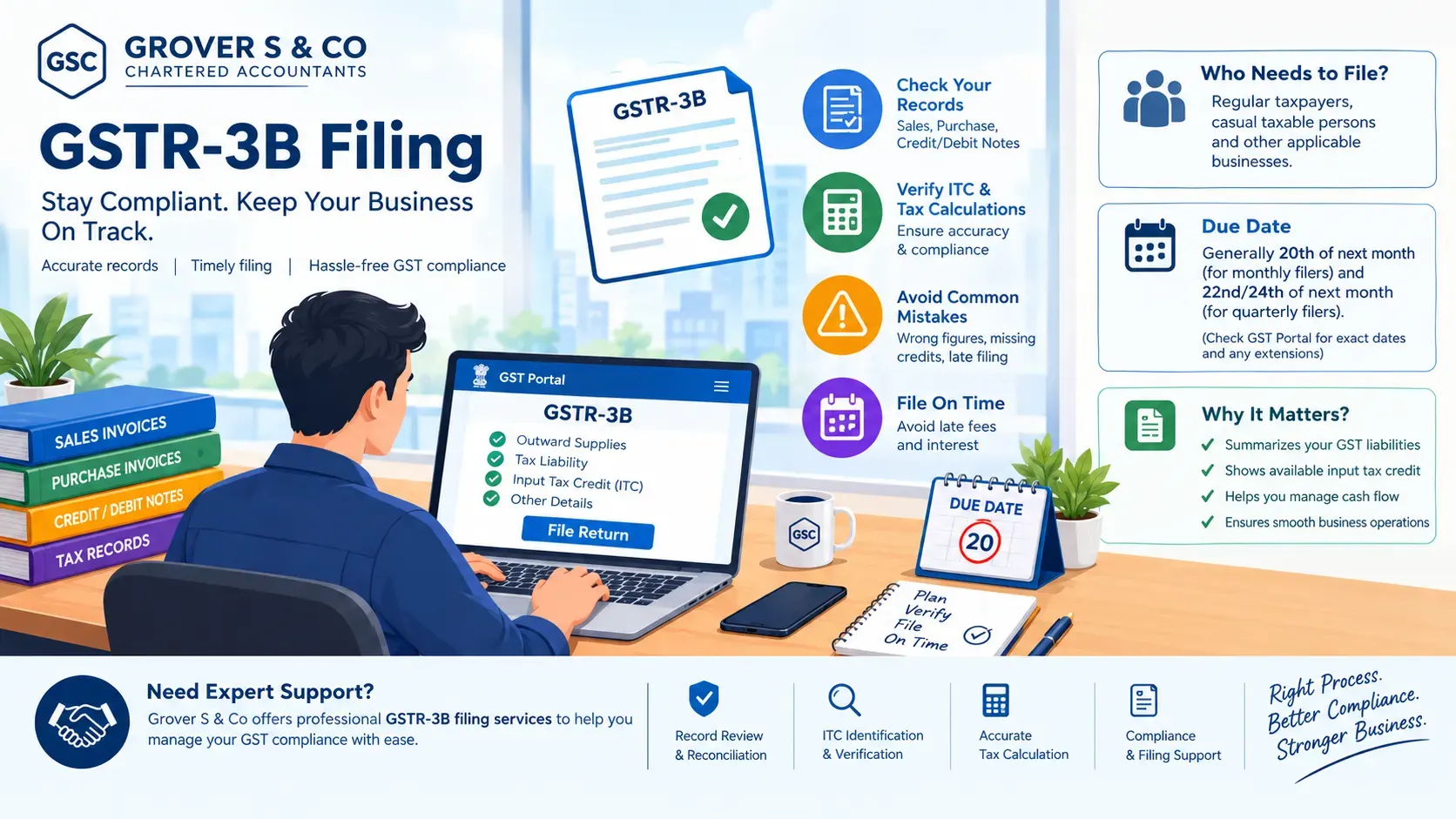
To comply with the legal requirements regarding GST on goods and services, companies need to have the correct systems for invoicing and bookkeeping. Additionally, all eligible taxpayers are required to report the necessary data on taxes accurately and submit the required filings before the relevant due dates.Thus, GSTR-3B is an important document as it provides a summary of the GST liabilities and available input tax credits of each taxpayer for a given tax period.
This return is useful for the business owners to ensure that their records are prepared timely, that they check their calculations and minimize errors in filing.If you have developed a consistent procedure, it will make managing GST compliance much simpler, whether you are a startup, trading operation, service provider or a running organization.
What is GSTR 3B Filing?
GSTR-3B is a summarized form of tax return, which is filed electronically on the GST portal by all taxpayers covered under the relevant provisions. This return is used to report a summary of your outward supplies, the amount of tax due, the eligible input tax credits (ITCs) claimed by you during the tax period and other additional details as may be required. In contrast to a detailed invoice-level statement, GSTR-3B provides a consolidated view of your business activities.
figures reported on the return must be based on business records and must comply with relevant GST laws. All taxpayers need to review the information provided on the return, whether it is auto-populated or not. Figures used to complete the return can help in completing the return, however they cannot take the place of verifying the data.
Who Needs to File GSTR-3B?
A casual taxable person or regular taxpayer typically has to submit GSTR-3B for each of the tax periods that apply. The requirements for submitting a return will vary by type of business, therefore, it is important for businesses to determine what rules apply to their registration. Even when a business is not active, a return may be required.
Only if the portal’s criteria are satisfied and the taxpayer has no transactions, no reportable liabilities, no input tax credit (ITC) claims, and no other factors which prevent Nil filing, can the Nil return be filed. Just because a taxpayer doesn’t have sales, it does not mean they may file a Nil return.
What Is the GSTR-3B Due Date?
The general deadline for most monthly tax filers is typically the 20th of each month that follows the reporting month. Most quarterly filers will file their taxes by the 22nd or 24th of the month following the quarter in which the filing is being made. The actual date will depend upon the filer’s state/Union Territory and applicable categories. Since the government may extend these deadlines, it is recommended to visit the GST Portal to determine if any extensions apply to your specific reporting period.
When you file on-time, it allows your business to better control when you make payments and reduces the chance that you will be charged any late fees or interest charges. Having a compliance calendar, knowing when your filing deadlines are, and keeping organized records can help to reduce the stress of filing at the last minute.
Records to Check Before Filing
Organize your Sales & Purchase Invoices, Credit Notes/Debit Notes, Tax Rate (as per applicability) and Tax Paid Records prior to preparing GSTR-3B. Review the Eligible ITC and identify Credit which is either restricted or requires reversal under the GST Rules.
Differences in sales reporting or purchase-related credits may be revealed by comparing the proposed return to GSTR-1, as well as to the GSTR-2B statement that you have access to. Rather than simply copying figures from one document to another, take the time to investigate any differences. It is also very important to maintain proper documentation when the supplier has not provided you with their information yet, or if there is a problem with the invoice and it requires clarification.
Common GSTR-3B Filing Mistakes
Typical mistakes include reporting wrong sales numbers, filing for tax credits that are not applicable to the business, failing to report reverse-charge liability, and failing to meet the filing deadline. In addition to these types of errors, businesses can omit credit notes from their returns, as well as fail to match up data reported on various GST returns.
Prior to submitting, review tax calculations, verify ITC eligibility, examine discrepancies and view a draft version of your return prior to making payments and submitting. After filing, GSTR-3B cannot be edited directly. Any necessary changes or adjustments must be completed during a later filing period as per the regulations.
How GSTR-3B Filing Services Can Help
Professional assistance can make preparing your GST returns easier by providing an organized approach to processing multiple invoices, multiple tax rates, and/or complex ITC records. Professional assistance will also help you double check your math, compare your records against those of the government, and find any errors prior to filing. However, you are ultimately responsible for supplying all required information and supporting documentation to your professional advisor.
Grover S & Co provides support for business with recurring GST compliance through GSTR-3B filings. This could involve reviewing your records, identifying your eligible input tax credit (ITC), evaluating your reported liability, and then preparing your return based on the data provided and your applicable compliance requirements.
For further information, please go to the GSTR-3B Filing Services web site. Check out the service details to find the correct amount of assistance that meets your compliance requirements.
Conclusion
To file GSTR-3B accurately, businesses should maintain proper records, ensure that the ITC is correct, calculate taxes correctly and file their return on time. Businesses will be better prepared for the filing process and find it easier to find ways to fix mistakes once they know what needs to be in the filing process.Businesses that need help with the filing process may want to consider the use of professional filing services that can provide a more organized way of complying with the GST laws.
Frequently Asked Questions About GSTR-3B
Is filing GSTR-3B mandatory?
Yes, eligible regular and casual taxpayers registered under GST are generally required to file GSTR-3B within the applicable due dates. However, filing requirements may vary depending on the taxpayer category and applicable GST provisions.
Can I file GSTR-3B if I have no sales?
Yes, you can file a Nil GSTR-3B if you have no sales or other reportable transactions, no eligible input tax credit to report, no reverse charge liability, and no outstanding interest or late fees payable for the relevant period. You should verify all applicable conditions before filing a Nil return.
Can I claim input tax credit in GSTR-3B?
Yes, eligible taxpayers can claim input tax credit (ITC) through GSTR-3B, subject to the conditions and restrictions under GST law. Ensure that you have the required supporting documents and have reconciled your purchase records with the available GST data before claiming ITC.
FAQ
Frequently Asked Questions About GSTR-3B
Learn about GSTR-3B filing requirements, Nil returns, input tax credit (ITC), applicable GST rules, and the importance of accurate and timely GST return filing for businesses.
Yes, eligible regular and casual taxpayers registered under GST are generally required to file GSTR-3B within the applicable due dates. However, filing requirements may vary depending on the taxpayer category and applicable GST provisions.
Yes, you can file a Nil GSTR-3B if you have no sales or other reportable transactions, no eligible input tax credit to report, no reverse charge liability, and no outstanding interest or late fees payable for the relevant period. You should verify all applicable conditions before filing a Nil return.
Yes, eligible taxpayers can claim input tax credit (ITC) through GSTR-3B, subject to the conditions and restrictions under GST law. Ensure that you have the required supporting documents and have reconciled your purchase records with the available GST data before claiming ITC.