For businesses which are required to collect and remit Goods and Services Tax (GST), obtaining a GST registration is one of the initial compliance actions. The ease of applying for GST through an online application has made this process less complex, however, applicants must submit relevant business information, complete the verification process, and satisfy the applicable criteria.
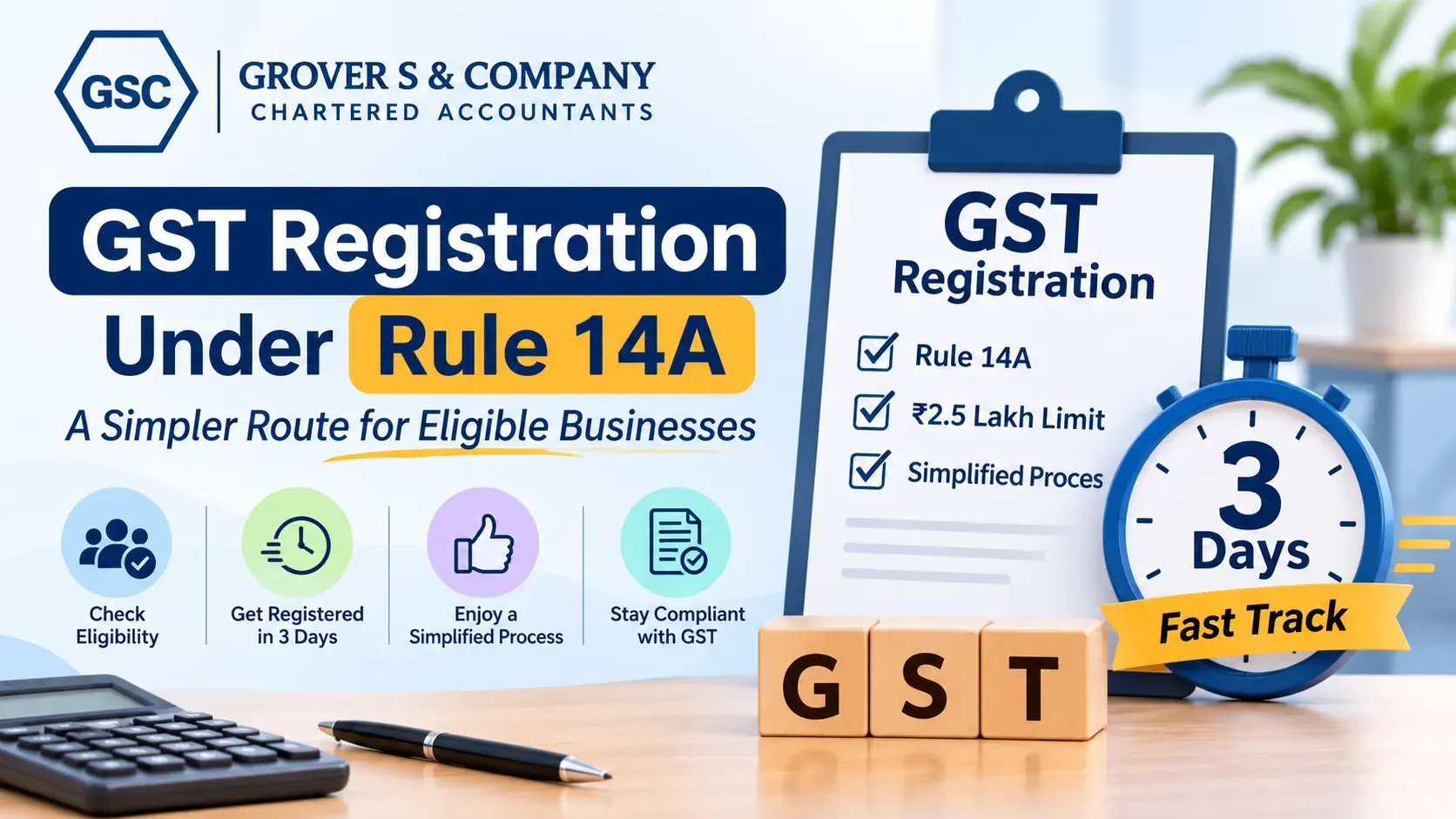
In order to make this process easier for some of the tax payers, the Government of India has introduced Rule 14A under the Central Goods and Services Tax Rules, 2017 (CGST Rules, 2017) which will be effective from 1 November 2025. This rule allows a business to optionally register itself if it is a business that meets the eligibility criteria and has a specific amount of monthly output tax liability on the supplies provided to registered persons.
For qualifying businesses, the simplified registration process can provide for a more timely completion of GST registration and may eliminate several of the normal administrative processes associated with the application.
What Makes Rule 14A Different from Regular GST Registration?
The primary distinction is the eligibility based registration process and the reduced approval time.
The normal process allows for further review and/or explanation, based on what was provided in the application, and the situation of the applicant. Rule 14A has established a simple electronic method for those applicants who meet all the requirements.
Eligible candidates will be able to get their GST registered within three business days as long as they pass through Aadhaar verification and meet all of the other criteria.
However, the above option is not mandatory. Businesses should determine if they are eligible for the above option prior to selecting it as opposed to assuming that all first-time applicants for GST may utilize this option.
Eligibility Conditions for GST Registration Under Rule 14A
The primary requirement for this process is related to the amount of tax that an individual is required to pay each month based on their monthly sales. In other words, the total tax due from the sale of goods/services to registered individuals can never exceed ₹2.5 lakh each month.
The limit applies to all relevant CGST, SGST, UTGST, IGST and Compensation Cess. It should be noted that the limit is based on tax liability, not the business’ monthly sales.
Applicants are required to undergo Aadhaar Authentication as specified by the Authorized Signatory and at least one Promoter or Partner, except as otherwise provided.
A second requirement is that one cannot apply for more than one registration per state/union territory, per PAN, using Rule 14A.
All requirements should be reviewed thoroughly prior to the submission of the application.
How to Apply for GST Registration Under Rule 14A?
The user can submit their application online via the GST Portal with Form GST REG-01.
At the time of application submission, applicants are required to input their company details (including the name of the company), location/address of the company, what type of business the company engages in, and the names of the individuals who will be involved in the management/ownership of the company (promoters/partners). In addition to inputting all of this information, applicants must indicate that they would like to apply for registration under Rule 14A.
Required documentation must be provided by uploading it and the prescribed aadhaar authentication procedure must be followed.
After the application has been sent in a proper manner, the department will begin processing the application using the simplified method. If the department finds that you have met all of the requirements for your license, then the department will issue your license in no more than 3 business days.
Correct information provided at the start of a process will help prevent delay caused by incorrect information or missing documentation.
What Happens If Your Business No Longer Meets Rule 14A Conditions?
The amount of business activity and taxes that you owe may vary from year-to-year. If you have been qualified under Rule 14A, it is important to remember what the rules say about qualifying each year. You should not treat your application to qualify under Rule 14A as a single-time decision.
In order for a registered person to pull out of the program, they must file a digital application using Form GST REG-32. This is based on the terms and conditions outlined for pulling out of the program.
Additionally, prior to submitting an application for a withdrawal, the taxpayer must confirm that all necessary returns have been filed and all applicable compliance requirements are met.
Reviewing the applicable laws prior to making this determination would be beneficial, especially if your company is now conducting more business with registered clients.
Is Rule 14A Suitable for Your Business?
Rule 14A is a viable option for businesses that will have expected transactions that fall under the applicable tax liability limits, and are looking for an easier registration procedure.
The decision, therefore, will be based upon the type of business, its anticipated clientele, and its GST obligation. If a business does not qualify under the terms of the conditional registration process, then it must apply for GST registration using the standard application process.
Before you apply, understanding the above information will prevent making false statements on your application, which could lead to potential issues down the road.
GSCCA is available to help businesses determine if they are eligible for GST registration, and what documentation is required. GSCCA also assists businesses in meeting other GST-related compliance issues.