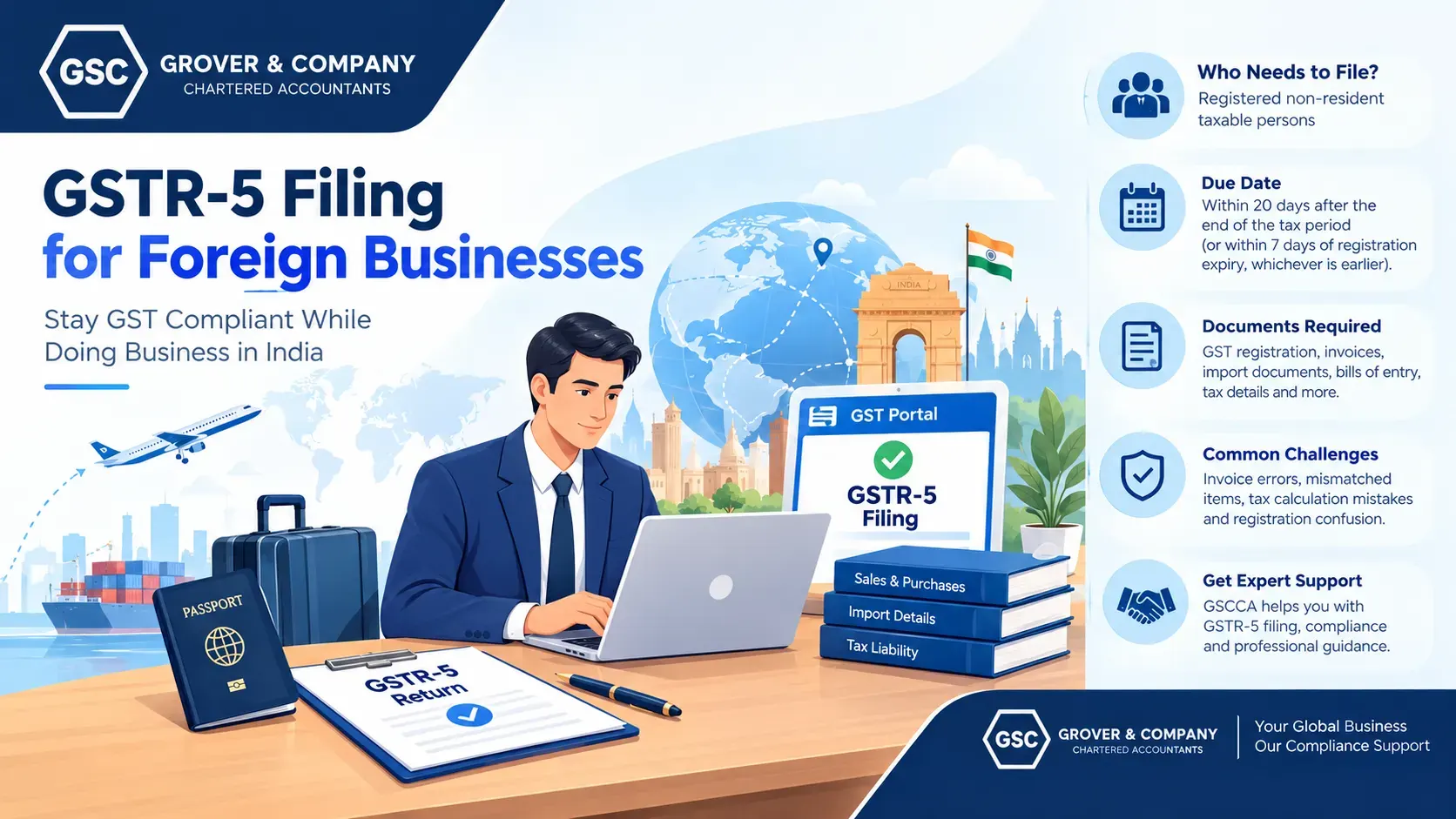
The Indian market has many potential benefits for foreign businesses. Companies and overseas professionals providing goods/services into India will need to know about the taxes they owe. A key aspect of the Indian Goods and Services Tax (GST) is that it requires GSTR-5 filing.
GSTR-5 was created for registered non-resident taxable persons. Knowing who should file this return, the information needed to complete it and when to file it will allow foreign companies to meet their GST requirements.
What Is GSTR-5 Filing?
GSTR-5 is a monthly return for non-resident taxable persons (registered) to file electronically with the GST Portal. This return includes all of their inward supplies, outward supplies, and applicable tax liabilities during each relevant tax period.
The reporting requirements for GSTR-5 are unique to foreign businesses who temporarily conduct taxable activities in India, and are distinct from those applicable to domestic businesses submitting standard GST returns.
Which Foreign Businesses Need to File GSTR-5?
GSTR-5 applies to registered non-resident taxable persons under Indian GST law.
A non-resident taxable person is usually defined as either an individual or business who from time to time carries out transactions related to providing goods or services within India, either as a principal, agent or otherwise, and also doesn’t reside in India and/or doesn’t have a permanent location for doing business in India.
These could be international traders, foreign companies exhibiting products/services in India, or overseas companies that are temporarily selling taxable goods/services in India.
Every international company does not automatically fall into this category. The applicable GST registration requirements for an international company depend upon the type of business activity and transaction(s) that are carried out by the international company.
GST Registration Requirements for Foreign Businesses
Foreign companies that are required to file taxes as non-residents will need to complete the application process using Form GST REG-09 via the GST website.
An application for a business license must be filed with the Indian Government at least five business days prior to the commencement of any business activity within the country. All applicants will be required to submit all necessary documentation, such as a current and valid passport, if appropriate.
A foreign based person who will be paying taxes in India must have a representative (authorized signatory) that lives in India and has a valid PAN. Also, the person will likely need to make a prepayment of the tax they expect to owe during the time they are registered.
Business owners who register correctly will have met their GST requirements from day one.
What Is the Due Date for GSTR-5 Filing?
GSTR-5 is usually due to be filed no later than 20 days after the end of each tax period for which it applies, or within seven days from the date on which your GST registration expires, whichever occurs first.
For instance, if a foreign company’s registration period ends prior to the regular monthly filing date, the foreign company will be required to meet the first deadline.
Timely filing of your returns is critical since any delay in filing could lead to a fine, interest, or other non-compliance penalties under the GST Act.
Documents and Information Required for GSTR-5
Before preparing a GSTR-5 return, foreign companies must organize all of their transactions and other supporting documentation.
These can include GST registration information; sales invoices; purchases invoices; import documentation; bills of entry; taxable amount; GST rate(s) applied; and the detail of taxes paid.
An accurate reporting system will allow for proper tracking of incoming and outgoing inventory as well as reduce the potential for reporting errors on your tax returns.
Common GSTR-5 Filing Challenges
Foreign-owned companies will likely experience difficulty in navigating Indian GST processes because they have no previous experience in dealing with Indian tax laws.
Challenges include: wrong invoice details; differences between the imported items listed on the invoice and the items received; errors made during the calculation of taxes; and confusion regarding the status of your registration and when you are required to submit returns.
Ignoring these regulations may lead to avoidable compliance problems. Businesses that examine each of their transactions prior to filing their returns are able to prevent many common errors.
How GSCCA Can Help With GSTR-5 Filing
Having an understanding of the way in which to manage your GST compliance within a foreign country is essential to managing your GST compliance. It will be much easier for you to manage the compliance if you use professional help to ensure that the compliance is as organized as possible, which will lower the risk of having to file a return with a mistake that could have been avoided.
GSCCA offers help in filing GSTR-5 returns by non-resident taxable persons. Businesses are able to receive expert advice on reviewing transactions, knowing what is required to file, and completing all required GST compliance.
We can assist your business through the use of our GSTR-5 Filing Services. To find out what we offer, please take a look at our GSTR-5 Filing Services page.
Conclusion
Registered non-resident taxable persons doing business in India have to file a GSTR-5. A foreign company must understand the process of registering with GST, the documentation required for filing, and the due date of each return in order to better handle its tax obligations.
Professional help from GSCCA allows businesses to file their GST returns with more confidence, as well as have an increased level of compliance.