
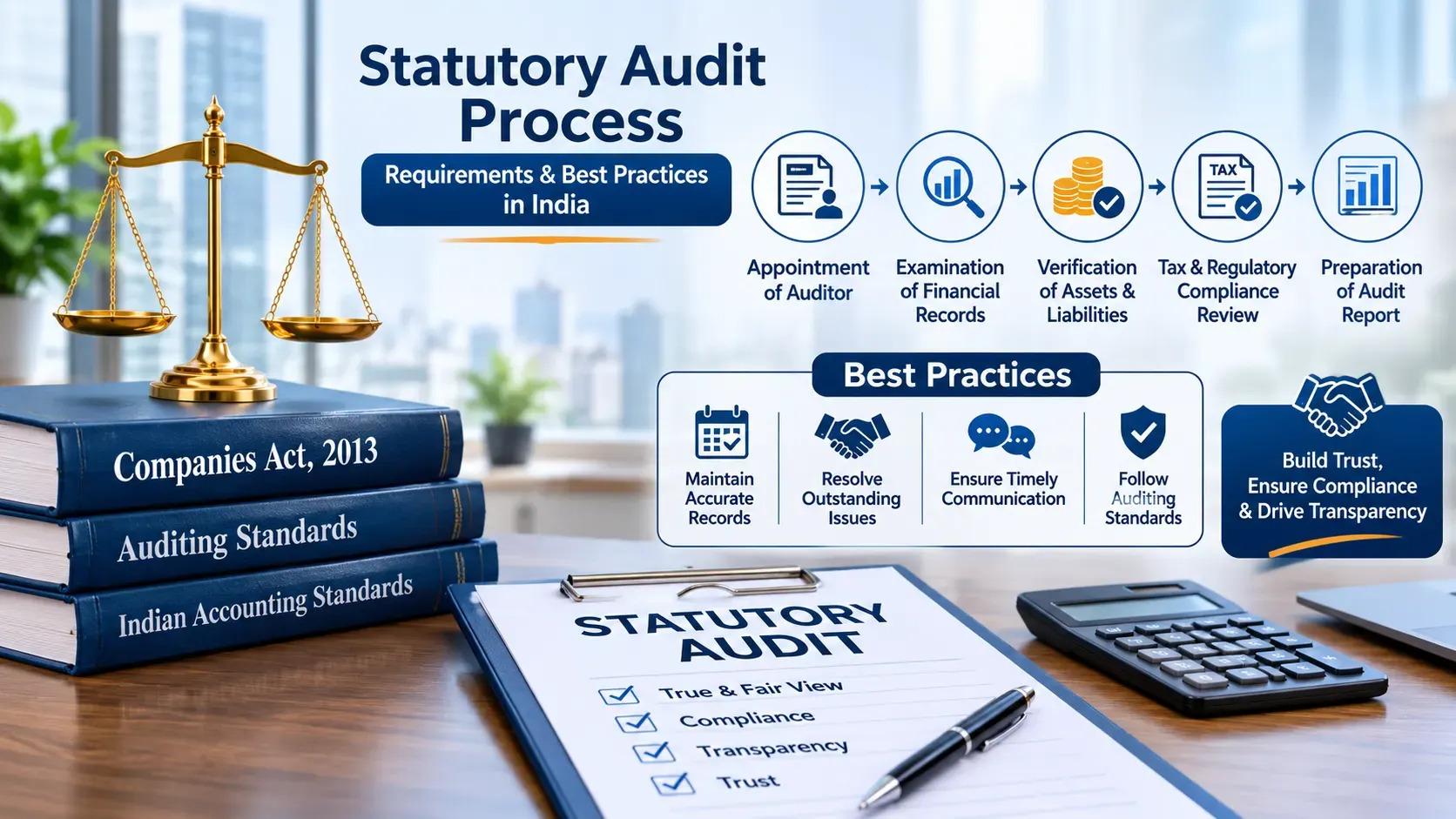
Statutory auditing is important in India to ensure that financial regulations are followed. A statutory audit verifies if the financial statements reflect a true and fair view of the company’s financial status, business operations, revenue and expenditure. While it meets regulatory obligations, a statutory audit enhances transparency in financial reporting and enables organizations to detect errors in accounting practices, inconsistencies in reporting and areas where they may be non-compliant.
Under the Companies Act, 2013, all companies must have a statutory audit performed on their financial records by a qualified Chartered Accountant. Knowing about the statutory audit process, the applicable laws and regulations, and best practices will help companies get ready for the statutory audit and minimize the likelihood of experiencing problems with compliance.
What Is a Statutory Audit?
A statutory audit is an independent examination of the financial statements of a business organization and associated accounting records to ascertain whether they are in accordance with relevant laws and accounting standards.Typically, a statutory audit will include the balance sheet, income statement (or profit and loss statement), statement of cash flows, supporting documentation and any other financial information that may be deemed appropriate for the purposes of a statutory audit.
The primary goal of a statutory audit is to provide an independent opinion on the accuracy of the company’s financial records in relation to the company’s present financial condition. A statutory audit provides a sense of responsibility for the actions taken by management within the company and increases trust and confidence in the company for shareholders, creditors, investors and other interested parties.
Statutory Audit Requirements Under the Companies Act, 2013
The statutory audit requirements for Indian companies are largely regulated through sections 139-148 of the Companies Act, 2013. These sections provide the rules regarding the selection of an auditor, who can serve as an auditor, what are the responsibilities of the auditor and what are his/her reporting duties.
Generally speaking, every company registered under the Companies Act must hire an external auditor (statutory) regardless of how much money they generate or lose. In order to qualify as a statutory auditor, you will need to fulfill the criteria specified in Section 141; usually this means that you must be a practicing Chartered Accountant.
The provisions under Section 143 specify the role and responsibilities of the auditor. These include the right to access all relevant financial data, to seek additional information as may be necessary to complete the audit process and to present a separate and objective audit report. In addition, each company is required to maintain its books of accounts, supporting documentation and financial reports in compliance with both applicable accounting standards and statutory regulations.
Understanding the Statutory Audit Process
Appointment of a Statutory Auditor
The statutory audit begins when the company selects an auditor that meets the requirements of Section 139 of the Companies Act, 2013. Depending upon whether this is the first auditor for the company or a later selection, there will be different procedures followed to make the selection. Additionally, the company must obtain the required approval from its board of directors and meet all applicable regulations.
Examination of Financial Records
After being appointed, the auditor reviews the company’s accounting records (books), financial statements, banking records, purchase and sale documentation, invoices, expense reports, etc., to determine if all of the company’s financial activities have been correctly documented and categorized.
Verification of Assets and Liabilities
The auditor verifies the accuracy of the reported assets and liabilities, such as bank balances, outstanding loans, trade receivables, inventory, fixed assets and any other financial obligation. The use of supporting evidence and reconciliation will verify if the reported figures are correct.
Tax and Regulatory Compliance Review
The statutory audit is also concerned with reviewing how a company complies with relevant tax laws and regulations. The types of compliance reviews conducted depend upon what the company does, however, some examples of what can be reviewed are GST records, TDS deductions, income tax provisions, statutory payments and any other applicable legal obligations.
Preparation of the Statutory Audit Report
After the completion of the auditing process, the auditor will review the results of their work and then prepare a written report regarding those results. This written report will contain an opinion as to whether the financial statements are presented fairly and in accordance with generally accepted accounting principles (GAAP), and will identify any qualifications, observations, or other matters that are required by the governing laws.
Best Practices for a Smooth Statutory Audit
Maintaining correct financial records for each month during the financial year will significantly ease the pressure of the statutory audit. Companies need to perform regular bank reconciliations, check the accuracy of their ledgers, and maintain accurate records of invoices and payments.
In addition to being organized with all of their accounting records, companies should also make sure they have reviewed any outstanding statutory liabilities and resolved any issues prior to when the audit begins. Timely communication between the management team, accounting department and statutory auditor enables quicker resolution of issues that may delay the process.
The use of suitable auditing standards, the maintenance of the auditor’s independence and the existence of sufficient documentation of the audit process result in high-quality audits and accurate financial reports.
The significance of professional support in statutory audits
Statutory audit compliance is more than just checking the accuracy of a company’s financial statements. A business needs to be aware of the company law that applies to it, what are the relevant accounting standards, how to prepare and present its financial reports in accordance with those standards, and what are the applicable tax laws. Professional chartered accountants can assist a business in organizing its business records, help a business understand its statutory audit obligations, and identify any accounting or compliance problems that may arise during the course of a statutory audit.
For many businesses located in Delhi, as well as those throughout India, utilizing the services of a professional chartered accountant (CA) firm will provide a more systematic approach to preparing for their statutory audit and allow management to utilize greater control over the financial aspects of their business.
Conclusion
The use of a properly managed statutory audit process assists with providing transparency in financial reports, compliance with regulatory standards and responsible management of the business. Companies who understand what is required of them for statutory audits as outlined in the Companies Act 2013, and practice good accounting techniques will find that they are able to perform their annual audit more efficiently and effectively. Companies may also benefit from conducting periodic reviews of their finances and receiving advice from professionals on how to prepare for statutory requirements at all times during the year.