
Introduction
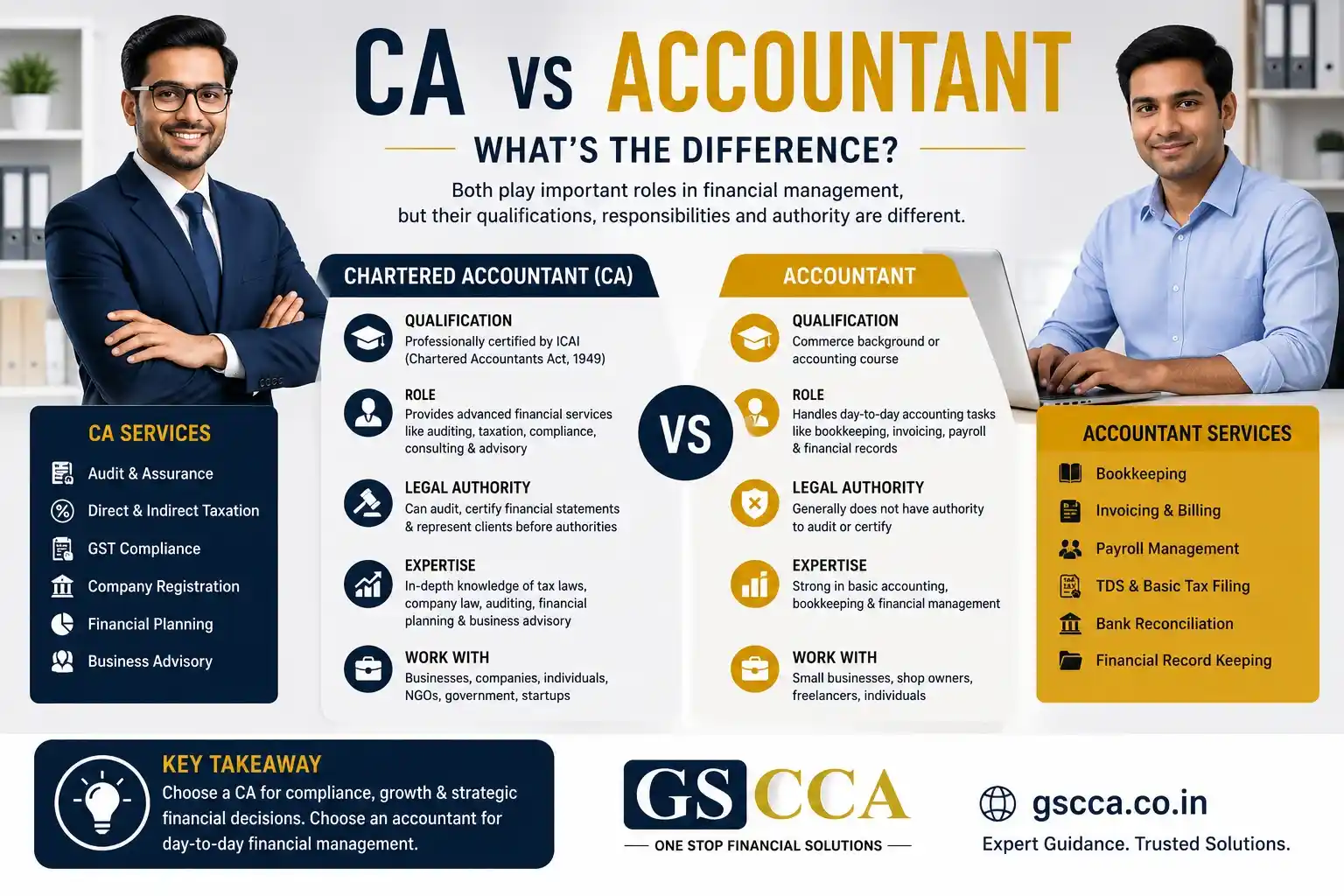
Most of the people confused CA with Accountant, But Both are Different. Though both professionals are involved with financial records, taxation and business accounts, their occupational standing, duties and legal authority are vastly different. For businesses, startups, freelancers and other individuals who need professional financial assistance, it is essential to understand the difference between a Chartered Accountant (CA) and an accountant.
Companies employ their bookkeepers for daily upkeep, handling accounts like how to manage updates and expenditures, while Chartered Accountants focus more on financials-associated information about tax rates and compliance, audits. Selecting the right expert depends on complexity of financial needs and business objectives.
What is an Accountant?
An accountant takes care of record keeping as well as day to day accounting activities of businesses or individuals. Chiefly, they are tasked with keeping track of all income, expenses, invoices, payroll and any financial transactions.
Accountants assist a business with organizing their financial data and regularly maintaining bookkeeping practices. They can also prepare financial accounts, handle billing systems and help with simple tax calculation. Multiple businesses depend on accountants for their operational financial management and internal record keeping.
But not every accountant is certified, which may lead to the inability to carry out a statutory audit or represent clients at legal hearings regarding issues in high-level taxation, for example.
When I say Chartered Accountant (CA), what do you think?
A CA refers to a Chartered Accountant that is internationally protected title given to accounting professionals who have completed rigorous exams and training through the Institute of Chartered Accountants of India (ICAI). The education required to be a CA includes an extensive knowledge base in taxation, auditing, corporate finance, compliance and financial law.
Legal Rights: CAs are empowered legally to perform audits, i.e., typing on financial documents about clients, and represent them at tax authorities. They generally get into businesses in terms of complex taxation structures, GST compliance, business registration, company law aspects and financial planning.
One of the key duties also performed by a Chartered Accountant is to ensure that businesses comply with the financial regulations in India.
Difference between CA and Accountant
Qualification and Certification
Professional qualification is one of the biggest differences between a CA and an accountant. An accountant may have only general knowledge of accounting or a background in commerce, whereas a CA is required to pass professional certification exams and training (also called articleship) as well as qualify through both regional examinations and a national exam managed by ICAI.
This specialized training provides CAs with an enhanced level of expertise in areas such as taxation, auditing, legal compliance, and financial advisory services.
Scope of Work
In contrast, an accountant specializes in keeping track of financial records and managing day to day accounting activities. Their work minimally supports the day to day business operations and some financial organization.
The role of a Chartered Accountant is far wider as it involves tax planning, audits, financial compliance, company registration, business consulting and legal finance representation.
Legal Authority
CAs are authorised by law to carry out statutory audits and get some financial documents certified which the government authorities and regulatory bodies ask for. These tasks are regulated by law and cannot be legally performed without proper certifications possessed by an authorized individual (which accountants generally do not have).
Which Type of Professional is a Must for Your Business?
The CA vs Accountant debate arises only when business needs are to be fulfilled. At first, small businesses are often dependent on accountants for bookkeeping and managing invoices. But as businesses expand, the need for professional financial planning and compliance increases.
Any business related GST filing, audits, taxation disputess or company registration should win your CPM services from Chartered Accountant for support on every such fiscal matters. It reduces compliance risk and improves financial decision-making at organisations as well, particularly those who are just starting up or want to grow.
GSCCA, providing firms with the expert taxation and compliance assistance they’re seeking.
for Chartered Accountant and Accounting Services.
Importance of Professional Financial Guidance
Banks or credit unions will ordinarily preclude this practice, and Financial missteps accomplish earnest legitimate and operational issues for partnerships. Penalties and notices may be issued for inaccurate filing, ineffective management of compliance or misinformation on reports.
Hire a professional financial consultant and recording of accurate records, Transparency, Keeping the tax regulations properly in check. Even if your business has the minimum requirement in human resources recognizing the changing financial laws during management and properly facilitating it, chartered accountants work legally at tax-optimization levels as well.
Every business, even in today competitive environment, have resolved for being financially planned than fixing the records. Sustainable business growth has made strategic financial management an imperative piece of this picture.
CA Career: 9 Myths about Chartered Accountants (CAs) and Accounts
People think accountants and CAs perform the same job. Both finance and accounting jobs work in the world of financial services but have different levels of knowledge and specificity.
Only big businesses need Chartered Accountants: Another myth involving how only big companies are able to afford chartered accountants In fact, Startups, freelancers and small business owners are also using professional CA services for GST registrations, tax-planning & business registration.
Being aware of such differences allows organizations to deal better with related financial matters and get the appropriate professional support.
Conclusion
Career advice in India: The difference between a CA and an Accountant is more than just the name. Accountants primarily handle financial records and day-to-day bookkeeping, while Chartered Accountants offer specialized knowledge in taxation, auditing, compliance, and business advisory services.
Although both professionals serves a value in business operations, the major difference comes in the skills and legal powers. Businesses that need sophisticated financial counsel, assistance with compliance issues, and strategies for tax planning should work with experienced CA firms including the likes of GSCCA
.