
Introduction
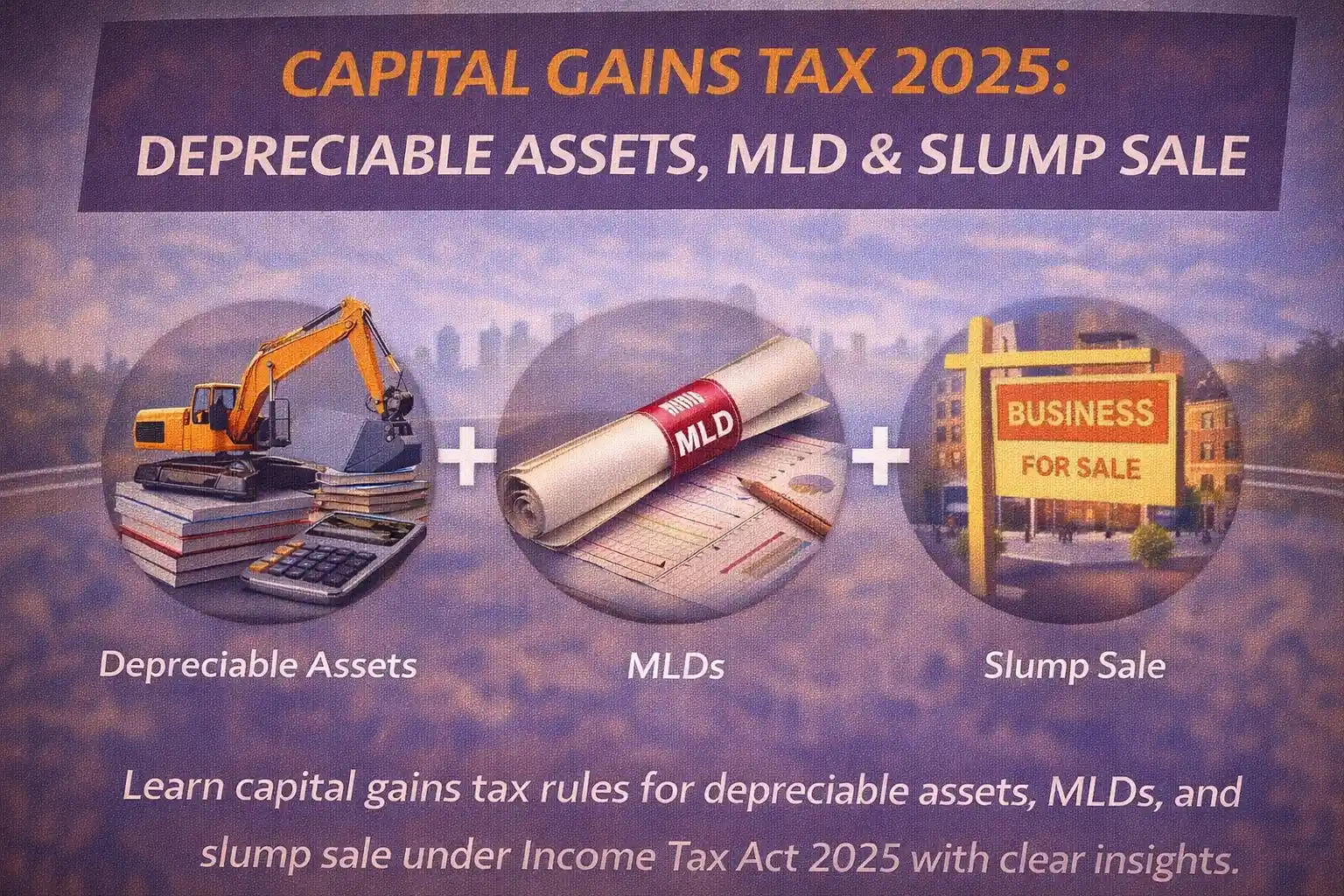
Capital gains tax plays a significant role in the context of the Income Tax Chain 2025 particularly for businesses and buyers in charge of executing the transfer of assets. Sale of depreciable assets, investments in market linked debentures and transfer of entire business through slump sale — each could have a different tax characterisation. It enables effective tax planning and compliance while keeping the unnecessary liability at bay with regard to these provisions.
What Are Capital Gains?
Capital gains are created when a capital asset is sold or transferred at a price higher than the asset’s original purchase price. The gain i.e difference in sale value and cost of acquisition is taxable.
Capital gains are classified into short-term and long-term gains under the Income Tax Act — 2025 according to a certain holding period of the asset.
Capital Gains on Depreciable Assets
Decorations assets are business expenses or exploited over the years, such as machinery, equipment and business vehicles. These assets are bundled in blocks, and you play taxes not item by item, but based on the block.
The gain is treated as short-term capital gain irrespective of the holding period for depreciable asset, if you sold it. This is a critical difference because it removes the benefit of long-term capital gain tax rates from these type of assets.
The calculation takes the proceeds on sale and compares it to the written down value (WDV) of the block of assets. When the selling price is more than the WDV difference is taxed as short-term capital gain.
Taxation of Market Linked Debentures
Market Linked Debentures (MLD) are instruments with a fixed maturity where returns are linked to the stock market or another market index or asset. Investors looking for bigger yields are starting to turn to them.
As per Income Tax Act 2025 any gain from MLDs is considered as short-term capital gain, regardless of the holding period. As a result, they are treated as ordinary income rather than long-term capital gains which are taxed concessively.
Such return is subject to tax and the post-tax return may differ considerably than what may be expected and hence should be factored in before investing in these.
Slump Sale and It Taxability
A slump sale means transferring of a whole business undertaking for a lump sum consideration without separating the value of individual assets and liabilities.
Slump sale is taxed under the head capital gains under the provisions of the Income Tax Act 2025. The gain is the sale consideration less the net worth of the business.
Net worth is the value of an entity through assets and liabilities as per books of accounts. This method guarantees prorated gains calculation without assigning a specific value per item.
Long-Term vs Short-Term Capital Gains
Tax rates are also affected by the fact that gain must be classified as either long-term or short-term. Long term capital gain is usually taxed at lower tax rates with indexation benefits.
However, in certain instances, such as depreciable assets and market linked debentures, such gains are treated as short-term irrespective of the holding period. This emphasizes the need for provisions of specific assets.
Importance of Accurate Valuation
Having a correct value estimation is necessary for capital gain computation. Valuation errors can result to wrong tax computation which can ultimately lead to disputes with tax authorities.
The process of a slump sale entails a looking through the financial statements and correctly documenting the net worth of the business.
Compliance and Documentation Requirements
To receive capital gains, proper documentation is crucial. This includes purchase invoices, depreciation records, financial statements, and sale contracts.
Without proof, you might incur penalties or have claims disallowed. Income tax & returns india proper filing ensures gains are reported accurately
How GSCCA Helps in Complying with Capital Gains
A GST and company registration company GSCCA helps businesses or individuals in capital gain provisions. Through being informative, just to remind that firms like GSCCA are serving for accurate computation and documentation & filing returns.
Created by Veterans in the online Income tax & returns handling field, Our expertise lays in helping the taxpayer manage his compliance in an efficient way and error in reporting penalties.
Common Mistakes to Avoid
One of the common mistakes is treating depreciable assets to long-term capital gains advantages. A related one is wrong determination of net worth in slump sale transactions.
For example, overlooking tax implications on financial instruments such as market linked debentures can also create a situation of unexpected tax liabilities. You can always prevent these mistakes by taking the advice of a chartered accountant.
Practical Tips for Tax Planning
Ideally, taxpayers will heed the above wealth transfer maxim as they shift assets around, so that the taxpayer who pays that tax bill the same time. Knowing how you asset will work and what tax rules will apply to you
Keeping your books in order and seeking advice from a tax accountant keeps you in a better position to handle your taxes and stay compliant.
Conclusion
Capital gains sections of Income Tax Act 2025 such as relating to depreciable assets, market linked debentures, slump sales, etc — conduct due diligence and structuring of transactions need to be meticulously planned. Every category of income possesses different sets of rules which directly affects the income tax.
Taxpayers can stay in control of their tax obligations by establishing the relevant documentation, as well as the obligation to ensure correct valuation and compliance with applicable requirements. It is important that capital gains taxation be managed efficiently, but it can also bolster long-term financial planning with the proper knowledge and guidance.