
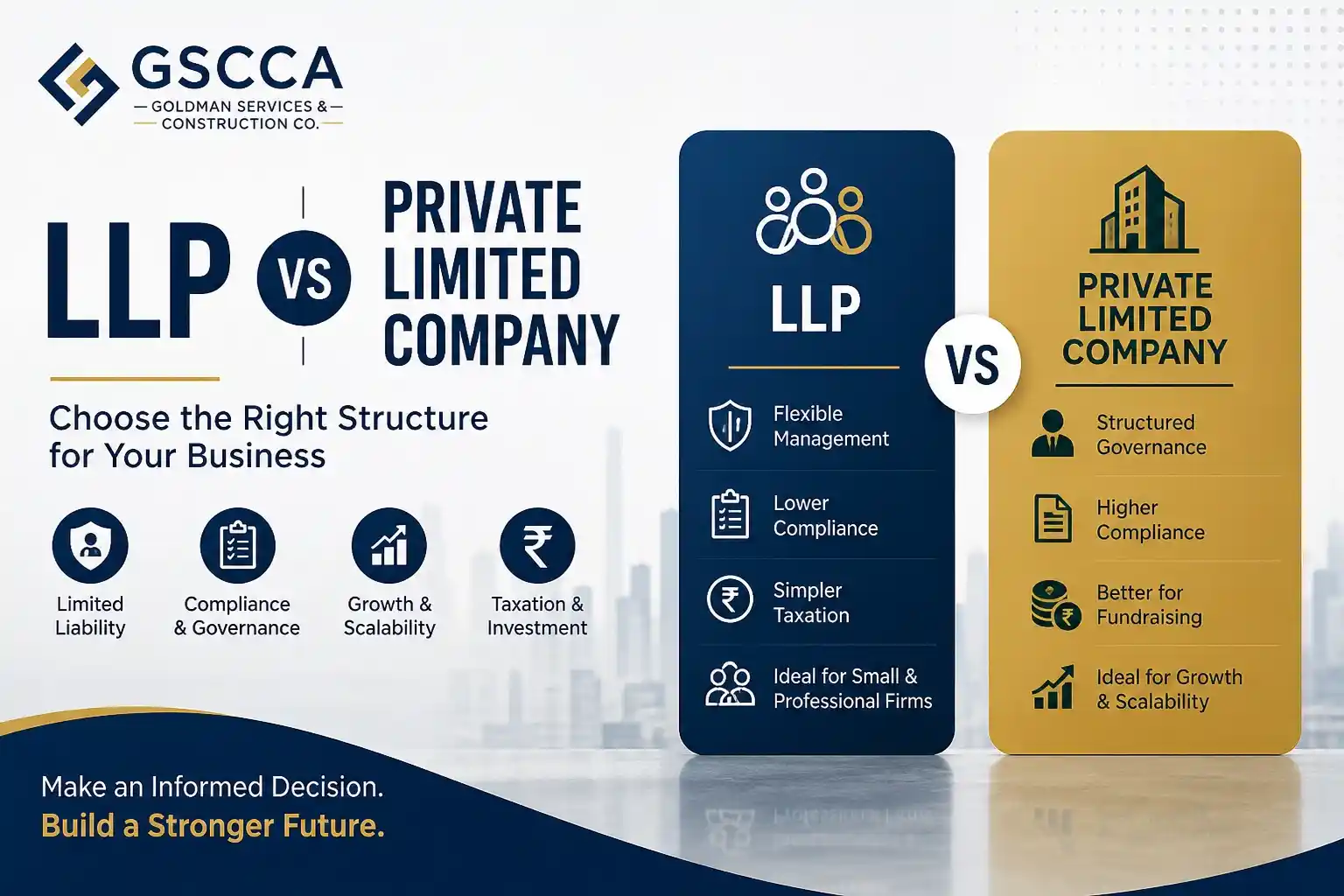
One of the biggest and most crucial decisions that every entrepreneur has to make in India is regarding the right business structure. Some of the most highly preferred options are Limited Liability Partnership (LLP) and Private Limited Company. Each are distinct models that offer several advantages, but differ greatly in compliance, taxes, ownership and scalability.
Contrast of LLP and Private Limited Company can drive you towards the right decision which concurs with your business needs, future roadmap or developments intended.
What is an LLP?
A Limited Liability Partnership (LLP) is a business structure that combines both partnership and limited liability features into one program. Regulated by the LLP Act, 2008, an LLP is suitable for professionals, small businesses and service-based firms.
In an LLP the all partners directly manages business and their liability is limited up to their contribution. That means your personal belongings aren’t at risk of business loses.
Private Limited Company – What it is?
A Private Limited Company is a registered separate legal entity under Companies Act, 2013. Most startups and businesses that want to gain traction, raise funds, or establish credibility prefer it.
A private limited company has shares with ownership split into parts and the liability for shareholders is limited only up to their respective shareholding. This structure enables investments and ownership transfer more simply.
Difference Between LLP and Private Limited Company
Legal Structure and Governance
An LLP derives its existence from a partnership agreement between the partners and provides a flexible management with minimal formalities. On the other hand privately limited company has more structured governance system including directors and shareholders along with mandatory compliance norms.
Private limited companies are required to adhere by stringent regulatory norms which include holding of Board Meetings and filing annually whereas an LLP has far lesser compliance requirement.
Ownership and Management
An LLP is a partnership in which partners own and manage the business. It does not differentiate ownership from management.
Ownership (shareholders) is distinct from management (directors) in a private limited company. It enables far better scalability and professional management.
Compliance Requirements
Whereas, compliance is also a major difference between LLP Last come Private Limited Company. While the compliance requirements on LLPs are less stringent and there are lesser statutory requirements as well.
However, private limited companies need to follow various legal formalities (like audit, annual return and board meeting) irrespective of their turnover.
Fundraising and Investment
When you perform fundraising, private limited companies still enjoyed a clear upper hand. They have the ability to sell shares and can draw in investors like venture capitalists and angel investors.
This, in turn, makes LLPs a less suitable option for businesses that will be looking for rapid expansion or fundraising from outsiders.
Taxation
LLPs are taxed at single taxation without dividend distribution tax and thus, enjoy a simpler taxation track.
You are also required to pay full corporation tax on income earned by the private company, and potentially other taxes if or when profits are paid out as dividends.
Transferability
It is easier to transfer ownership in a private limited company by transferring shares, which can be executed smoothly.
LLPs are more complex vehicles and ownership cannot simply transfer without the agreement of the partners.
Scalability
The private limited company is generally a more suitable choice for long-term growth and trading. This helps establish credibility, funding opportunities and scaling.
For small or medium-sized enterprises where the growth vision is less ambitious, an LLP may be more suitable.
1 Similarities between LLP And Private Limited Company
But despite of these dissimilarities, LLP has some similarities with the Private Limited Company. Both provide owners with limited liability protection. This protects that your own personal assets would not be at risk in the case of potential business liabilities.
Which One Should You Choose?
LLP or Private Limited Company — which one is suitable is determined by your business goals.
You are small business, consultancy or professional firm and wish to have low compliance as well as low cost of having a such structure, LLP is the Answer.
If you intend to scale your business, raisea funding or develop a strong brand presence — then a private limitedcompany is the right structure to adopt.
How GSCCA Can Help You
Therefore, choosing the right business structure should involve open conversation with professionals. At GSCCA — Goldman Services & Construction Co., we help enterprises choose the suitable entity based on their objectives, industry domain, and need for compliance.
So whether it is your company registration, tax planning or compliance management work, our team makes it easy and hassle-free for every entrepreneur and startup to put their mind at ease on doing the best of business.
Conclusion
LLP vs Private Limited Company Before you Start Your Business: Knowing the Difference Is Very Important. While an LLP is less complicated to establish and more flexible than a private limited company, on the other hand a private limited company offers scope for expansion and investment (MDI).
Your business success of tomorrow relies heavily on your choice of proper structure today. Think about your long-term goals and seek expert advice before making a decision.