
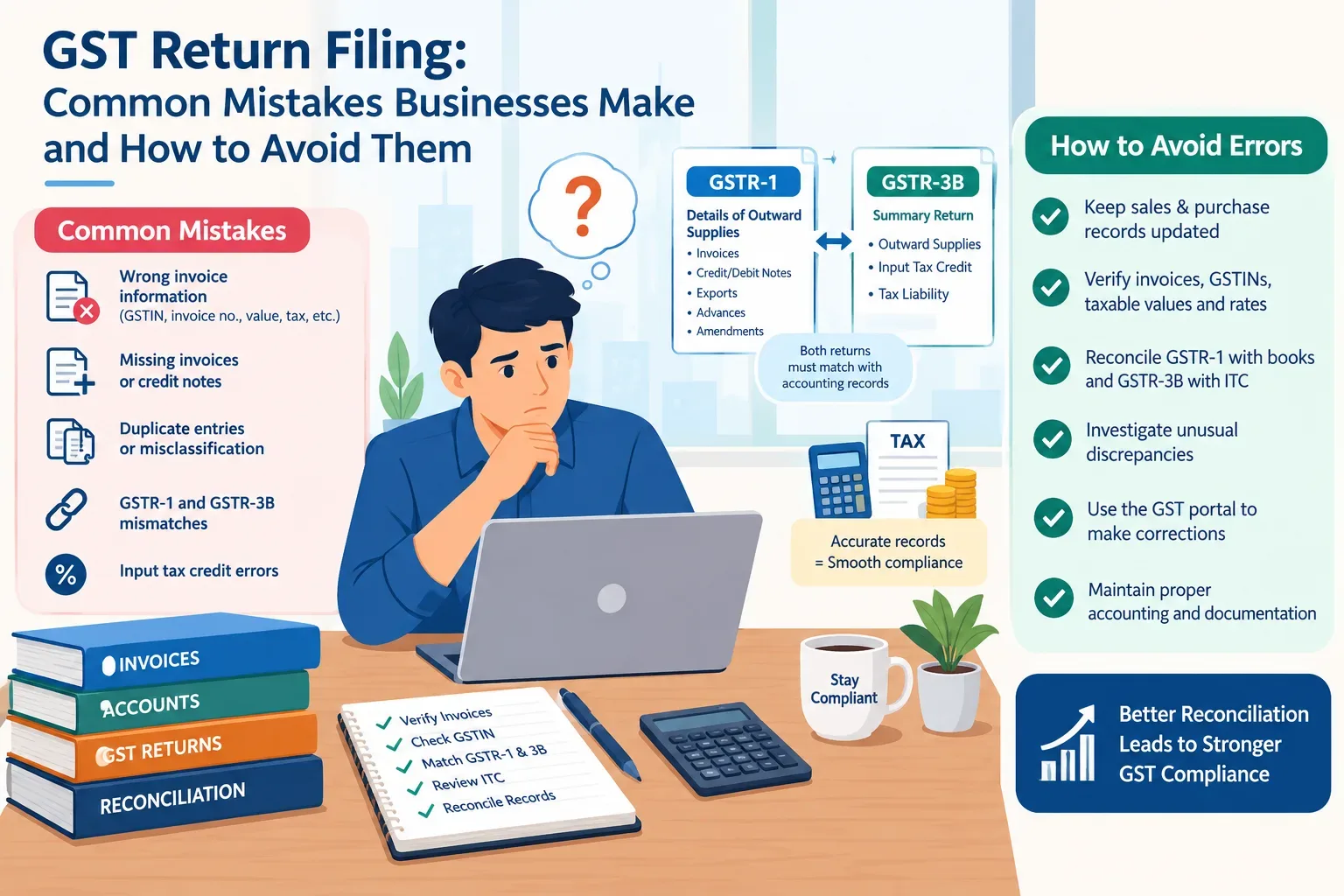
Filing GST Returns is a recurring compliance obligation for registered businesses in India. But, a return filed in time does not imply that the details are correct. Inaccuracies related to invoices, tax calculations, input tax credit, GSTIN details or reconciliation will lead to discrepancies and more compliance work.
Accountants draw on the data from your accounting records to comply with GST but this becomes difficult for small businesses, startups, freelancers, and growing companies when they do not keep their accounting records and GST information properly reconciled. Understanding frequent GST return filing mistakes allows businesses to detect errors beforehand and adhere to reliable tax records.
What Is GST Return Filing?
GST Return Filing refers to the filing of GST returns with GST authorities which includes reporting relevant business transaction, taxable supplies, tax liabilities and input tax credit availed. The specific returns and requirements vary based on the registration type of the taxpayer and the provisions under GST law.
GSTR-1 is generally used for furnishing the details of outward supplies whereas GSTR-3B provides a summary of specified outward supplies as well as input tax credit and tax liability for regular taxpayers. As the information that has been reported through these returns is interlinked, there should be a match between GST filings and accounting records maintained by the business.
Hence filing a GST return lat should not be considered just another online form until due date. Ensuring compliance with the GST Act involves proper handling of bookkeeping, invoices, reconciliation and reviewing them.
Common GST Return Filing Mistakes
One of the most common errors while filing GST is wrong invoice information. The businesses might have entered a wrong GSTIN, invoice number, taxable value, tax amount or place of supply. So any minor error would make a lot of trouble at the time when customer reconciles this transaction with their own GST records.
The other is for not reporting an invoice or credit note correctly. Businesses record some transactions in their accounting software for which GST is required but forget while filing GST return. Gst: You should also be careful while creating the credit and debit notes, as wrong reporting could lead to data mismatch between your accounting records & GST records.
There could also be cases where the same invoice has been reported more than once from a business or transactions being misclassified. These issues can be hard to spot when records are kept manually, however if the GST return is filed at the last moment.
Understanding GSTR-1 and GSTR-3B
If you want to file GST returns accurately, then it is necessary to understand the difference between GSTR-1 and GSTR-3B.
GSTR-1 mainly consists information of outward supplies. Each taxpayer, and their level of compliance, may consist of invoice-level data, credit/debit notes, export data, advances and amendments.
GSTR-3B which is a summary return for outward supplies, input tax credit and tax liability. Due to the interleave of information in these returns, any differences between them should be investigated not instead ignored.
Let us take an example of a business that has ₹10 lakh taxable sales booked in its books but reported only ₹9 lakh in the GSTR-1. Whether it was an un-invoiced charge, incorrectly recorded or reported in another period can cause the organisation to spend time later making sure that all the numbers match to those reported elsewhere.
Reconciling on a regular basis can nab such problems before they snowball into bigger compliance troubles.
Input Tax Credit Errors
Another area of caution is with input tax credit. Just because you record a purchase invoice in accounting records does not mean that the amount of GST can simply be claimed, without question.
Buyers may need to compare purchase records with the relevant GST information and investigate discrepancies. The invoice could be absent, incorrectly reported by the supplier, or recorded with wrong details, or other eligibility conditions under GST rules.
Such as if a business records purchase invoice with GST on its books, but the transaction for that is missing in respective GST Records this difference should be investigated prior treat amount eligible input tax credit by the business.
Reconciliation helps businesses understand the difference between real differences and accounting or reporting errors.
How to Avoid Errors during GST Filing by Businesses?
An effective way of minimizing GST return filing errors is to regularly revisit the transactions rather than waiting for the last moment.
Sales & Purchase records need to be updated continuously during the tax period. With deadlines for filing returns exiting end of the month, businesses should check invoices, GSTINs, taxable values, GST rates, credit notes debit notes and amendments before filing their returns.
External supplies reported in the GST returns should be reconciled with sales reported in books. In a similar manner, purchase documents ought to analyzed with particular GST records before taking input charge credit.
In a similar way, rather than massaging numbers to make records reconcile, organizations ought to investigate unusual discrepancies. This can be due to a missed invoice, timing difference, amendment, credit note, accounting mistake or incorrect reporting from the supplier. It is important to record the true cause.
What to do If You Commit an Error in Filing GST Returns
It is important to note that depending on the type of GST return filing error, time period, and relevant GST provisions; consequences may vary. While certain errors can be rectified through the available mechanisms, such as an incorrect reporting of tax liability or input tax credit — shown in his GST return — may lead us to take a further course of action.
Not every mistake is small enough to be overlooked by businesses. When an error is discovered, or suspected, it must be assessed whether what was reported originally was correct; what the report should have really been and even if a correction (or other action in accordance with a compliance function) is required.
Certain amendments and corrections are allowed through the GST Portal, as per conditions and functionality available on it. Rather than making unsupported adjustments in subsequent filings, businesses use the appropriate mechanism.
Why Regular GST Reconciliation Matters
GST Compliances are much wider than merely filing returns. Ganesh adds that for businesses, this requires dependable accounting records, invoices appropriately maintained, accurate tax calculations and periodic reconciliation with their GST reporting.
Companies that review their GST data on a monthly basis will spot missing invoices, duplicate entries, differences in input tax credit and discrepancies between GSTR-1, GSTR-3B and accounting records ahead of time.
Having this also makes it easier to respond to questions or discrepancies as the business already has relevant documentation.
For More Help with GST Compliance
GST return filing can be quite complex for businesses with multi-vendor transactions, input tax credit mismatches, multiple amendments (for registration) etc. The addition of professional review can create more order among clients’ filing and reconciliation activities.
Grover S & Company, a CA firm in North Delhi help you with your GST compliance requirement – filing GST return and tax reconciliation. For assistance with reviewing your GST records or establishing a GST return filing process, get in touch with Grover S & Company to discuss your businesses needs and the right compliance strategy.