
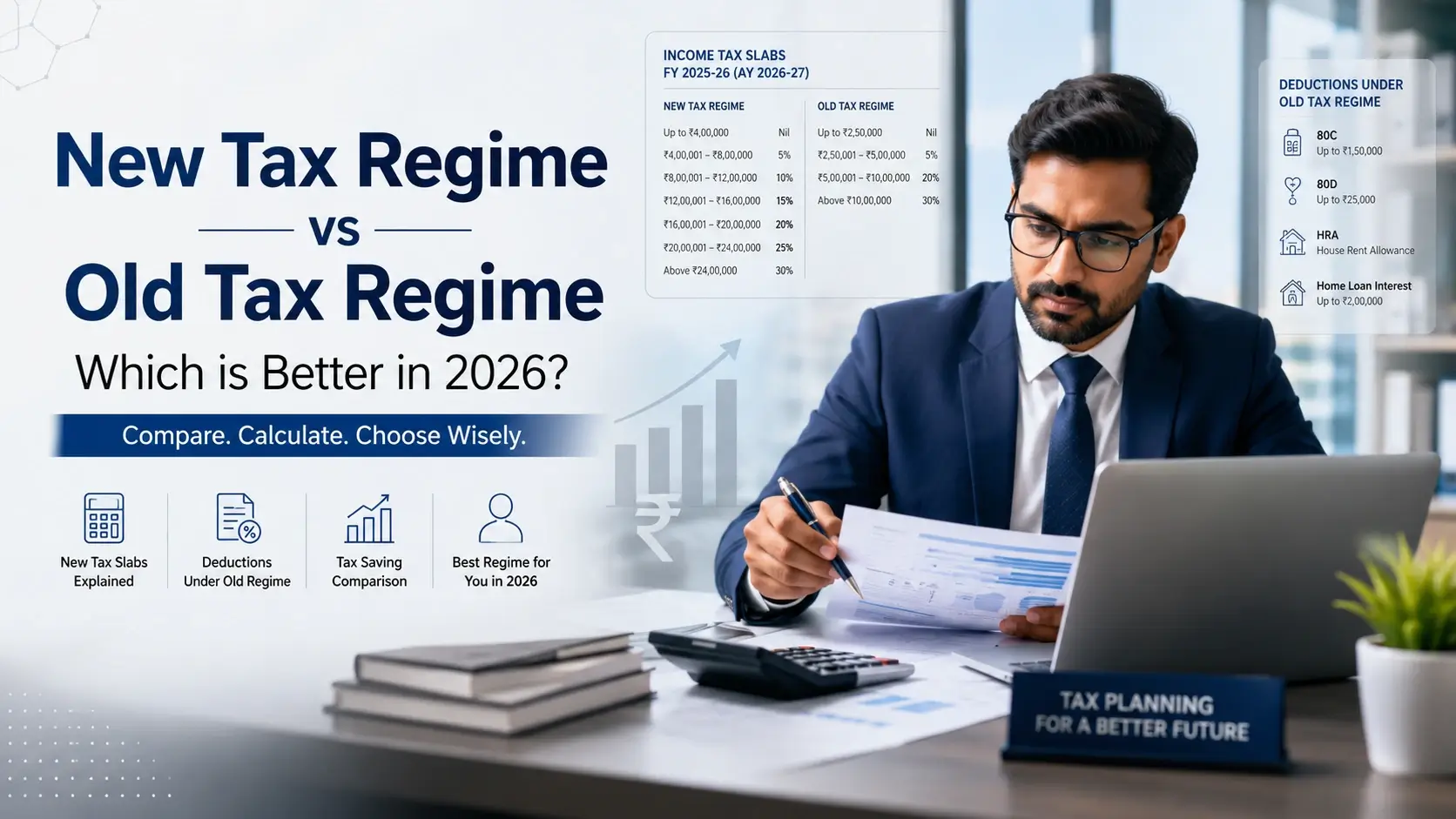
Making a decision of new tax regime vs old tax regime 2026 comes to be one of the most important financial decisions for Indian taxpayers. As income tax slabs, standard deductions and the focus on new age investments evolves continuously especially during budget time it further makes salaried class as well business professionals much more confused about which one actually helps them reduce tax.
The call on this for FY 2025–26 is less about trending and more dependent on your salary structure, investments, deductions & long-term financial planning. The new regime offers simplicity and lower tax rates but the old regime still has strong deductions that can lead to far lesser taxable income for most.
However, taxpayers whose Income Tax Returns are being filed in 2026 should understand the actual distinction between each of these two systems before making a final decision.
About the New Tax System in 2026
As such, the new tax regime was introduced to reduce hassles associated with income tax filing in India. Its lowers the requisite for getting away from most of the standard deduction/exemption way & receives you diminished tax slab prices.
The new tax regime mainly boasts of an easy-to-understand framework. With taxpayers not having to keep elaborate proofs of investment or plan around various exemptions. This is why it attracts young professionals, freelancers and those looking for liquidity instead of tax savings with Grover S & company.
Further an additional key benefit is the standard deduction allowed under new regime, which still favours salaried employees and pensioners. This, along with changes in tax slabs has made the new regime more attractive to middle income taxpayers.
But the simplified version also means that taxpayers lose out on prominent deductions such as 80C, HRA home loan interest benefits u/s Section -24 and several insurance-related exemptions.
Difference Between Old and New Tax Regimes in India
Explain the old vs new tax regime in India in one line: Lower Rates or more deductions?
The old tax regime enables taxpayers to lower their taxable income with the help of multiple incentives and exemptions. Section 80C investments, medical insurance under 80D, and HRA exemption & LTA claims bring down the total tax liability significantly. Education loan is also available for deduction by way of benefits enjoyed in terms of eligible interest paid on loans availed during a period when you are being assessed (generally up to first year after your graduation); hence, it is worth mentioning here: home loans have no threshold limit as no proper income classifiable distinction between personal or professional use can be achieved easily, unlike above deductions which directly relate to incomes – however, it does have its own intangible perk: borrowing power!
Most of these deductions are not available under the new system. Instead, the government makes up for them with lower taxes and simpler compliance.
The old tax regime deductions can therefore continue to bring down total taxes for people who tend to invest actively in a mix of tax-saving instruments even if the slab rates are higher.
What is the better tax regime for salaried employees by 2026
For salaried employees, the optimum choice depends on salary structure and annual deductions.
If you are receiving a good amount of HRA benefit, paying home loan EMIs or investing largely in ELSS, PPF, EPF and insurance policies then the old regime is likely to prove more beneficial. Claiming Deductions under Section 80C, Exemption of HRA (House Rent Allowance) and certain other old tax regime structures can significantly minimise taxable income.
However, professionals who have a bare minimum of investments or are offered limited exemptions could stand to save more under the new regime. People in startups, those at an initial stage of their careers or in rapidly growing industries, usually favour flexibility over putting money into schemes tending to lead to tax benefits.
This therefore makes 2026 the best tax regime for salaried employees, not a universal one. Tax Regime Comparison for FY 2025-26: The comparison must not be based on assumptions of income but rather actually computed between two rounds in both options.
Comparative Analysis of New Tax Regime and Old Tax regime with Examples
Lets take an example of a permanent employee who earns ₹12 lakh per annum.
If the employee avails of 80C investments, HRA exemption & medical insurance deduction, Old regime may substantially reduce taxable income. In several of these cases, it reduces the tax payable to below what is prescribed by new regime.
On the other hand, a new regime could save some taxpayer earning same amount with few deductions and not investing in tax-saver products at all if you find it difficult to file return.
This is where an income tax calculator for 2026 comes handy prior to making a choice of regime while filing ITR.
Year Six: Tax Planning for Salaried Employees
Tax planning need not just be about tax savings anymore. It has to fit in with larger financial goals.
Old regime benefits mutual equity investment and long-term financial planning. It might still be of benefit for people establishing retirement funds, buying homes or running structured insurance portfolios.
The new system is more suited to taxpayers seeking increased cash flow on a monthly basis, easier compliance and flexibility in investing. This route is now preferred by many freelancers and self-employed professionals since it lessens documentation work.
The essence lies here — understanding how your salary structure, deductions seek and financial commitments work along with current income tax slab 2026 provision.
Final Call: Which Regime can save you more taxes in 2026?
You cannot answer which tax regime is better in 2026 as it primarily depends on individual financial profiles.
Taxpayers who have significant deductions and more structured investments could still be better off under old regime. The new regime might be more efficient for those with lower exemptions or simpler finances — where liquidity preferences are higher.
Do a thorough comparison of both systems on realistic income / deduction estimates before you file your Income Tax Return when the time comes in 2026. Having experienced tax professionals to rely on also goes a long way in preventing any costly errors and capitalizing proper structuring as part of longer-term planning.
For a taxpayer confused between the new tax regime vs old tax regime 2026, expert guidance can transform this decision from being merely mathematical to strategic.