
Introduction
FDs (also known as Fixed Deposits) are one of the most-demanded investment alternatives among Indian investors owing to their low risk and assured returns. But many people do not know about the taxation of interest on FDs. Learn here how to pay income tax on fixed deposit interest income so as not to make mistakes and stay within the laws for income payment!
Fixed Deposit Interest Income — What Is It?
Fixed deposit interest income is the return that one earns on the fixed amount of money deposited with a bank or an entity for a fixed duration. The interest is credited every month, every three months or once a year.
And even if the interest is not taken out — and is put back into the investment — it is taxed as income for that year.
Taxability of FD Interest Income
Read more: Fixed deposits: Interest is entirely taxable under ‘Income from Other Sources’ You need to include it in your total income, and pay taxes on it as per the relevant income tax slab you fall under.
While major tax exemptions are available to other investments, FD interest is not among them and hence proper planning is essential.
TDS on Fixed Deposit Interest
As a general rule, banks deduct taxes at source i.e. Tax Deducted at Source (TDS) from FD interest amount when it exceeds the threshold limit during the financial year. As of now, TDS is levied only if the interest income crosses ₹40,000 (Which is about $540) for most people and ₹50,000 ($680 approx) for senior citizens.
They provide PAN the standard TDS rate is 10%. Rates can also go upto 40% if PAN is not submitted.
How to Determine Tax on the Interest from a Fixed Deposit (FD)
FD interest taxation Add total interest earned during a financial year to your total income.
Once this amount is included, your total income is taxed according to the slab rates. If your overall taxable income is in a higher tax bracket, then the FD Interest will also be taxed at a higher level.
Reporting FD Interest in ITR
FD interest needs to be declared under the head “Income from Other Sources” when filing the ITR.
The particulars about the same can be found in your bank’s interest certificate or Form 26AS/AIS. Accurate Reporting – It is ensured that there are no discrepancies during processing.
What If TDS Get Deducted Already?
Question:Many taxpayers believe that once TDS is deducted, there is no additional tax liability on their income. On the other hand, TDS is just a partial tax deduction.
Suppose the TDS you have deducted on your plans exceeds your tax bill; in that case, you may finally use such excess amount or appear for self-assessment tax before filing your return.
How to Avoid Excess TDS
If total income below tax limit, fill up and give Form 15G to bank (Form 15H for senior citizens)
This helps you with not getting TDS deducted from the interest you earn on your FD. But you can only do so if you satisfy certain eligibility criteria.
Old vs New Tax Regime
The interest on all FD is taxable regardless of whether you are under the old or new tax regime. But tax liability may vary based on slab rates and deductions.
Selecting the appropriate tax regime would help in minimizing your overall tax burden.
Importance of Advance Tax
You have to pay the advance tax if your total tax liability is more than ₹10,000 in a financial year.
This calculation also considers FD interest income and there could be penalties on account of interest for delayed advance tax remittance.
Common Mistakes to Avoid
A very common error is not reporting FD interest because they did not receive cash. Interest is taxable on accrual basis, not merely based when received.
Mistakenly depending on TDS alone and overlooking Final tax computation which may risk notices or penalty.
Role of Professional Guidance
Simple tips for tax implications on FD is confusing but the FDs with multiple deposits/banks take time to understand.
GSCCA is a GST and company registration specialized firm which helps individuals and businesses to manage tax filings. It goes without saying that it is always useful for professionals to properly report their Income tax & returns online, in line with the regulations regarding taxation.
How to Apply Tax On Interest Earned from Fixed Deposit – Tips
For example, diversify across various financial instruments with different tax implications, thereby lowering the overall tax bill. Tracking all your sources of income on a regular basis can aid you in managing your taxes more wisely.
Good record keeping and reviewing of bank statements will aid ITR filing on reporting accurate figures.
Benefits of Proper Tax Compliance
If you pay tax correctly on FD interest income, you would never face any kind of penalty/ legal issue. Also it makes the ITR filing process smoother and quicker point towards refund, if any.
Financial credibility is built through proper compliance and keeping your records clean.
Conclusion
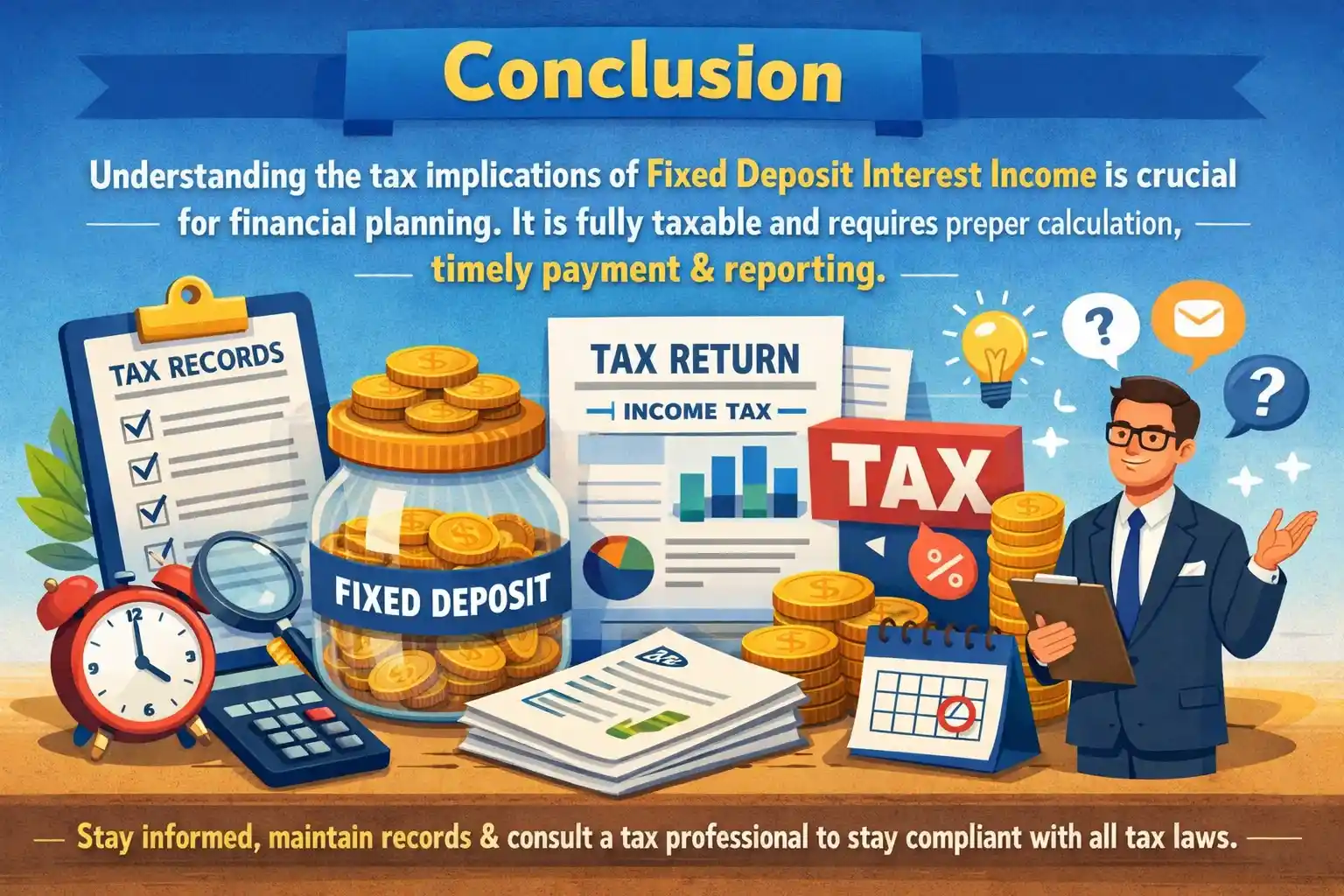
Hence it is very important to understand income tax implications of fixed deposit interest income for proper financial planning. It is fully taxable, and all only needs proper calculation, timely payment & appropriate reporting to account for it.
Taxpayers can stay in the know, maintain records and raise queries with a tax professional if required to effectively manage their FD income while remaining compliant with all applicable tax laws.