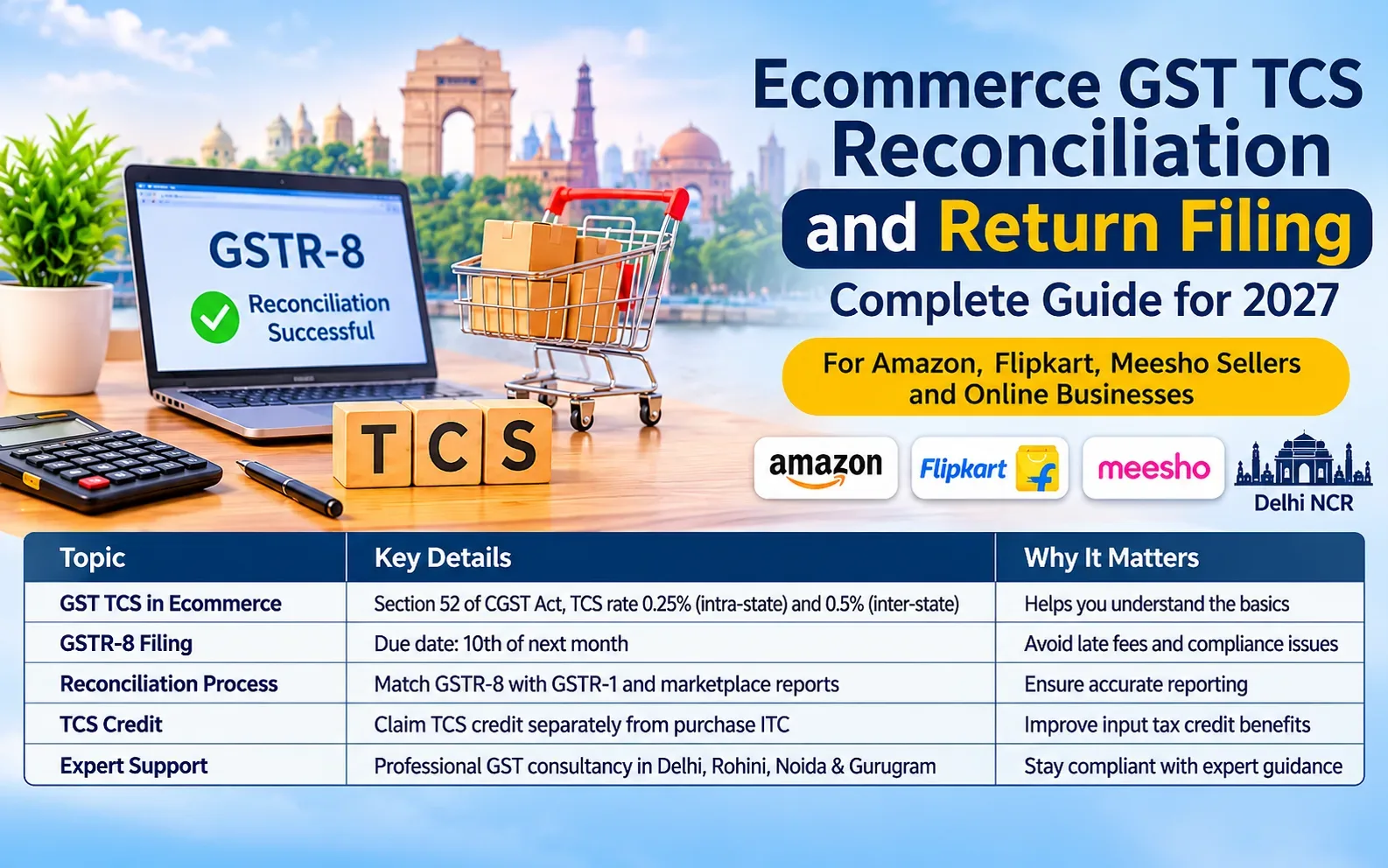
Ecommerce GST TCS reconciliation is the process of reconciling the Tax Collected at Source (TCS) reported by online marketplaces with the seller’s actual sales, GST returns and marketplace settlement records. Accurate GST reconciliation helps online sellers such as Amazon, Flipkart, Meesho and others in finding TCS mismatches, validating eligible tax credits and maintaining proper GST compliance. If you are running a business and want to hire an ecommerce GST consultant in Delhi NCR, you can get regular reconciliation and professional return filing support.
What is GST TCS for E-commerce Seller?
Section 52 of the CGST Act allows eligible e-commerce operators to collect GST TCS on the net value of taxable supplies made through their platforms on which they collect consideration on behalf of suppliers. Depending on the type and place of supply, the effective aggregate TCS rate will generally be 0.5% from 10 July 2024.
For intra-state transactions the TCS is bifurcated in to 0.25% CGST and 0.25% SGST or UTGST. For inter-state transactions the rate is IGST of .5% .
This provision is important for the online retailers as sales on marketplace, customer returns and settlement adjustments need to be properly recorded for GST reporting purposes.
What is Ecommerce GST TCS Reconciliation?
GST TCS reconciliation is done by comparing marketplace transaction reports with GSTR-8 details, seller’s GSTR-1 records and the TCS credit reflected on GST portal. This will allow businesses to see the differences between the reported taxable sales and the amounts collected by the marketplace operators.
For example, an Amazon seller may have recorded sales of ₹5 lakh in a month but customer returns, cancelations and other adjustments may affect the net taxable value considered for TCS. So the seller should compare the real transaction level records, not just the final bank settlement.
Key GST reconciliation information for online sellers
| Reconciliation Area | What Needs to Be Checked | Why It Matters |
|---|---|---|
| Marketplace Sales | Amazon, Flipkart and Meesho sales reports | Verifies actual transactions |
| GST TCS | TCS reported under Section 52 | Identifies collection differences |
| GSTR-8 | Details filed by the ecommerce operator | Confirms reported TCS |
| GSTR-1 | Seller's outward supply details | Supports accurate sales reporting |
| Customer Returns | Cancelled and returned orders | Helps reconcile net taxable supplies |
| TCS Credit | GST portal TCS credit records | Ensures eligible credit is accepted |
| Settlement Reports | Marketplace fees and payment adjustments | Explains differences in bank receipts |
GSTR-8 Filing and GST Compliance Return
GSTR-8 is the monthly return to be filed by eligible e-commerce operators required to collect GST TCS. It includes details of taxable supplies made via the platform and the TCS collected.
The due date for filing of GSTR-8 is generally the 10th day of the next month or as extended by the Government. Notably, the marketplace sellers themselves do not file GSTR-8. They should confirm the TCS details reported by the ecommerce operator and take appropriate action on TCS credit appearing in their GST portal account.
After acceptance of eligible TCS records and filing of relevant TDS/TCS Credit Received statement, accepted amount is credited to the Electronic Cash Ledger of seller.
Amazon, Flipkart, Meesho Reconciliation of GST
The different ecommerce marketplaces will have different transaction reports, settlement statements, commission details and return records. For Amazon GST reconciliation, you need to match seller transactions, refunds, fees and TCS deductions.Flipkart GST reconciliation includes sales reports checking, customer returns, marketplace adjustments and GST credit information.
Similarly, Meesho GST compliance requires sellers to verify order records, cancelation, settlement amount and TCS information.Proper ecommerce accounting and GST reconciliation helps you avoid differences in reporting across marketplace platform.
Common GST TCS Reconciliation Problems
Wrong GSTIN details, missed transactions, delayed reporting by marketplace, customer returns or differences between the marketplace statements and GST portal data can result in GST TCS mismatches for online sellers.
Another common problem is confusion between GST TCS credit and Input Tax Credit. These are alternate tax ideas. Eligible TCS credit is reflected in the Electronic Cash Ledger after the prescribed acceptance and filing process, whereas eligible purchase-related ITC is dealt with through the Electronic Credit Ledger.
Regular reconciliation helps Amazon, Flipkart and Meesho sellers to identify these issues before filing their GST returns.
GST Consultant for Ecommerce and Reconciliation Services in Delhi NCR
Managing daily business operations and marketplace GST compliance can be cumbersome especially if you are a seller on multiple platforms. A professional ecommerce GST consultant in Delhi can help businesses track their sales, reconcile TCS credits and manage their GST return filing needs.
GSCCA is a team of experts providing services like GST compliance, ecommerce accounting, GST reconciliation and return filing for the companies in Delhi, Rohini, Pitampura, Noida, Gurugram, Faridabad, Ghaziabad.
If you’re an Amazon seller in Delhi, a Flipkart business owner in Noida or a Meesho seller in Gurugram, getting GST TCS reconciliation right can help you report correctly and manage your finances better.
Are you looking for professional ecommerce gst reconciliation services and gst return filing services? You can reach out to gscca.co.in to discuss your business compliance requirements.