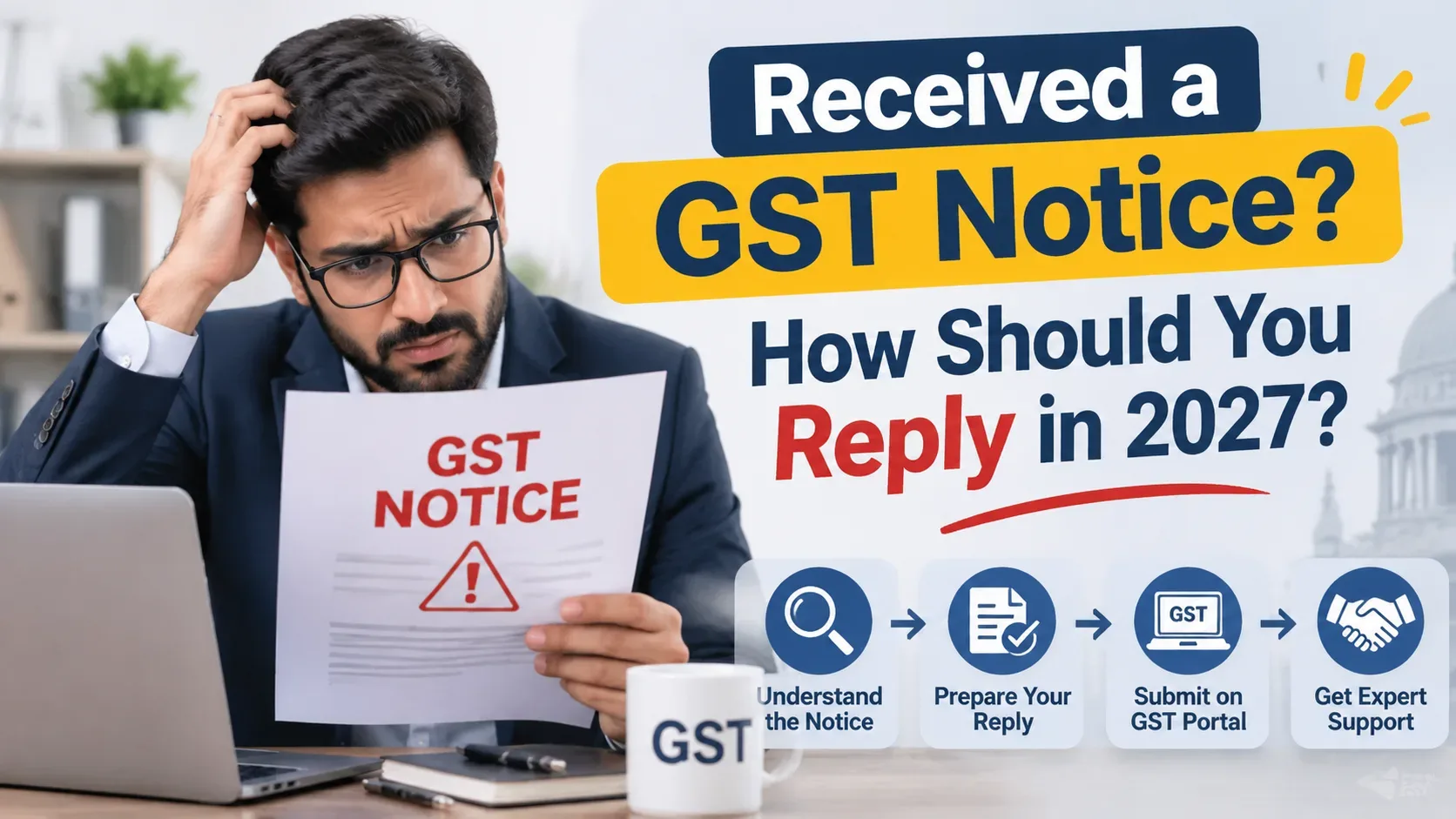
GST notices can be a source of stress, especially if they contain a tax demand, penalties, interest or any possible discrepancy in returns.However, a GST notice does not necessarily require immediate payment. Frequently, the department is simply requesting further details/explanations/clarification/supporting documentation.
In order for you to be successful with your response to the notice, you need to understand the reason behind why the notice was issued and you must respond to the notice within the specified timeframe. If you ignore the notice or submit a response that does not contain all of the required information then the problem may become much more complex than what it would have been if you responded promptly and completely.
Here is what businesses should know about replying to a GST notice in 2027.
Common Reasons for Receiving a GST Notice
GST notices can come about because of many different types of issues. For example, some relate to differences in the information submitted on your GST return. Other types of issues that could result in a GST notice include issues related to the amount of tax you paid, your input tax credit, or your registration status.
Common causes for these problems are: discrepancies between GSTR-1 and GSTR-3B; inconsistency between the amount of ITC (Input Tax Credit) claimed and the information available on record; excess ITC claimed, or incorrect ITC claimed; late return filing; underpayment of taxes; and errors discovered during an audit/assessment.
A notification may also be sent if the GST Department requires further explanation regarding a transaction, or requires additional documentation to support a transaction.
The type of notice that was sent will determine how you respond to the question asked in the notice.
Important Details to Check Before Responding
Read the entire notice before you look at the amount stated. Also find out: notice reference number, date of issue, financial year/tax period, applicable law/section, what is being alleged against you, and when you must reply to the notice.
You must also state what form is referenced within the notice. As an example, the ASMT-10 notice refers to errors/discrepancies found when examining returns. To respond to this type of notice, a taxpayer would use Form ASMT-11.
The demand related show cause notice may contain a summary in Form GST DRC-01. Generally the response to the show cause notice will be in Form GST DRC-06 which is required under the GST Rules.
You should not believe that all GST notices will have the same reaction process. The correct form and procedure to be used is based upon what kind of communication you receive.
Steps to Prepare an Effective GST Notice Reply
In order to make a suitable response, you will need to address each of the points raised in the notice. First, compare the observations made by the Department to your GST Returns, Invoices, Books of Account and any other records which are relevant to this matter.
For example, if the notice states that there is an ITC discrepancy, you should compare the credits taken on your returns with your applicable purchases and GSTR-2B from that time frame. Additionally, if the issue is about tax payments, you must review the liability, challans and returns filed prior to drafting your explanation.
Your answer should clearly state the facts of the case, and whether the department’s position was right or needs to be revised. Please provide as much supporting documentation as possible. In addition, please determine if there are any actual errors in the department’s findings, and then calculate what taxes, interest, etc., would apply if those errors were corrected, prior to making a decision about how to proceed with the matter.
Do not send a general response saying that the department’s calculation was wrong. Instead, provide a clear explanation with the documentation to support your claim.
How to File a GST Notice Reply Online
The GST website allows users to view notices and submit responses electronically. Depending upon the type of notice, the user can do this through the site.
You will need to first log into the official GST website. After you have logged into the official GST website you should go to the relevant notices and orders section of the site. When you find the notice that you want to respond to, you can then open it up and see if there are any options for responding to the notice. If so, you will need to choose the appropriate form or response method.
The user is being asked to provide a detailed explanation of why they are applying, to provide relevant supporting documentation, to carefully review the information provided prior to hitting “submit,” and to record either the acknowledgement or reference number associated with their application.
The reply for demand related show cause notices are typically submitted via Form GST DRC-06. The reply for scrutiny notices issued in Form ASMT-10 is typically submitted through Form ASMT-11.
Consequences of Not Responding to a GST Notice
If you do not respond to a GST notice, then it is possible that there will be subsequent proceedings against you. Depending upon the type of notice you receive, and the applicable laws, the Department may proceed with your case based on what is currently in their possession (records), or they may issue an order, or they may take other actions.
Difficulties in addition to those created by the matter (tax demand, interest, penalty or input tax credit) may be caused to a business.
In case you require more time, find out if the relevant process provides for a request for extension. Do not take for granted that the deadline will automatically be extended.
When Do You Need Professional Help for a GST Notice?
A professional would be helpful if you receive a notice that covers more than one tax period, if there are issues regarding your use of ITCs, if there are discrepancies between your filed return(s) and what was reported on the notice, if the amount of tax demanded is substantial, or if you need to provide a very specific legal answer to allegations contained within the notice.
A GST Professional can review the notice, reconcile all of the relevant records, determine which provisions apply and write a well-organized response with supporting documentation. Additionally, a GST Professional can assist in determining if paying the tax, providing clarification or obtaining additional legal services is necessary.
At GSCCA, businesses may obtain help with their GST notices (review), reconciliations (preparation of responses) and other compliance-related GST issues. The correct method for dealing with these issues will depend upon the facts and documentation that are relevant to each specific case.
Final Thoughts
When you receive a GST notice, don’t worry about it too much and don’t pay anything until you’ve checked the details. Take some time to read the notice thoroughly, determine what the problem is, check all of your records, and send in a complete answer by the specified date.
A response that is both timely and supported with evidence will provide clarity on your position as well as help avoid potential problems. When the notice contains a large amount of money requested or a complex GST problem, it may be beneficial to obtain advice from a professional prior to filing a response.
Note:GST laws, rules and forms are subject to modification. You must file your answer or other required paper with the court within the time stated in this notice, the court’s instructions and the law.