TDS Rate Chart FY 2026-27 is useful for Businesses, Professionals, Employers and Tax payers to know how much tax has to be deducted from various payments in India. The Income-tax Act, 2025 has been brought into force from 1st April, 2026 and the provisions relating to TDS are now under revised section numbers. And it’s important to understand what rates apply, what limits apply to deductions and what the rules are for compliance.
What will the TDS rate be in 2026-27? The most prevalent TDS rates are 1% or 2% on payments to contractors, 10% on professional fees, 2% on technical services, 2% or 10% on rent and 2% on commission or brokerage, depending on the nature of the payment. These provisions are mainly under Section 393 of the Income-tax Act, 2025. Salary TDS is covered under Section 392.
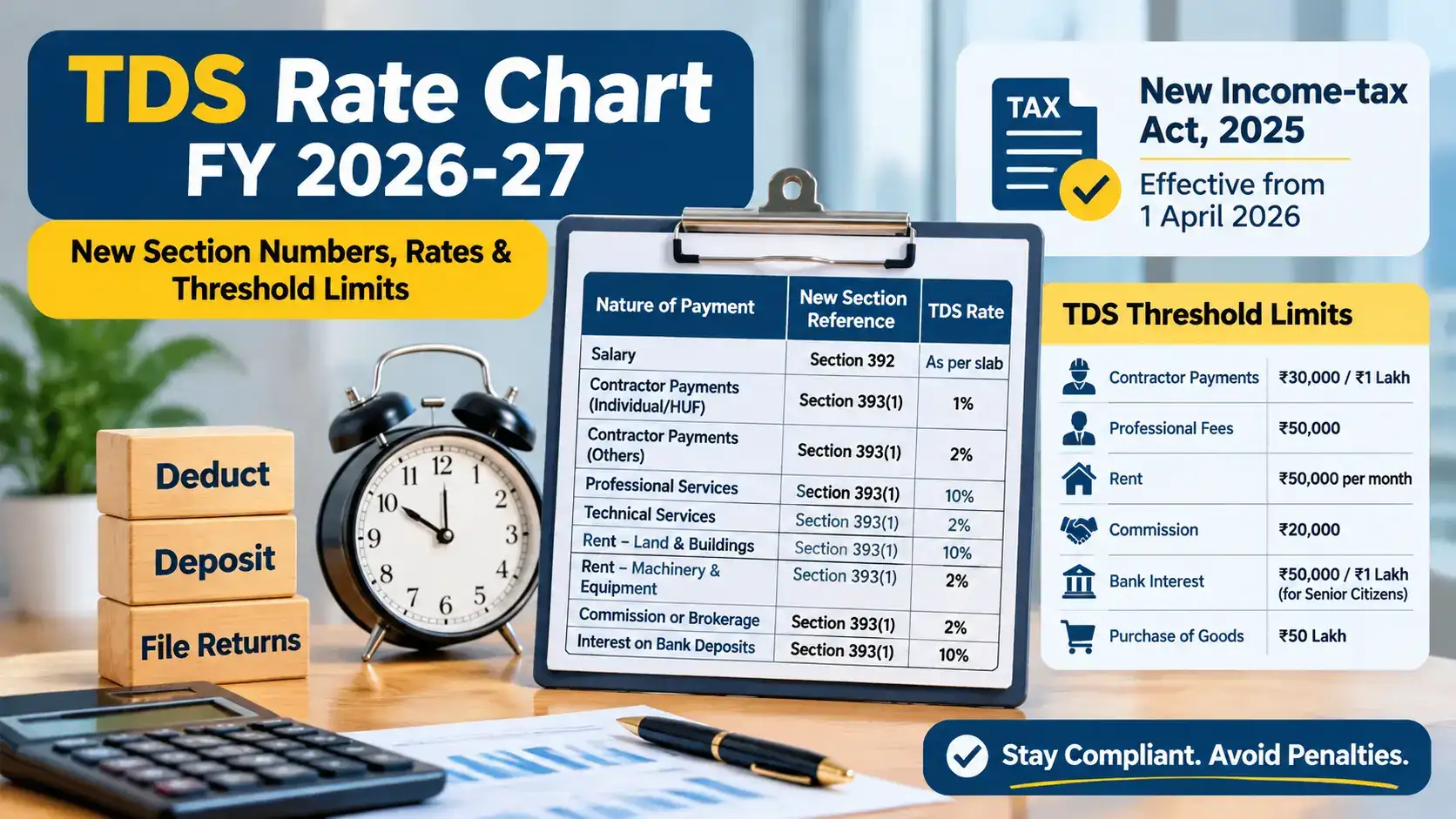
TDS Rate Chart FY 2026-27 Under Income-tax Act, 2025
The new Income-tax Act, 2025 reorganises TDS provisions into a simplified structure. Although the section numbers have changed, the government has largely retained the existing TDS rates and monetary thresholds.
| Nature of Payment | New Section Reference | TDS Rate |
|---|---|---|
| Salary | Section 392 | Applicable Slab Rate |
| Contractor Payments (Individual/HUF) | Section 393(1), Table 6(i) | 1% |
| Contractor Payments (Others) | Section 393(1), Table 6(i) | 2% |
| Professional Services | Section 393(1), Table 6(iii) | 10% |
| Technical Services | Section 393(1), Table 6(iii) | 2% |
| Rent – Land and Buildings | Section 393(1), Table 2(ii) | 10% |
| Rent – Machinery and Equipment | Section 393(1), Table 2(ii) | 2% |
| Commission or Brokerage | Section 393(1), Table 1(ii) | 2% |
| Interest on Bank Deposits | Section 393(1), Table 5(ii) | 10% |
TDS Rate Limit For FY 2026-27
TDS is applicable only if the payments are above the prescribed monetary limits.Knowing where these thresholds are helps businesses avoid improper deductions and compliance issues.
| Payment Category | Threshold Limit |
|---|---|
| Contractor Payments | ₹30,000 per payment or ₹1 lakh annually |
| Professional and Technical Fees | ₹50,000 annually |
| Rent | ₹50,000 per month |
| Commission or Brokerage | ₹20,000 annually |
| Bank and Post Office Interest | ₹50,000 annually; ₹1 lakh for senior citizens |
| Purchase of Goods | ₹50 lakh annually |
Depending on the respective payment category and statutory conditions, the limits are As a rule, once the relevant threshold is breached, TDS is levied on the whole of the amount and not just the excess amount.
What has changed in TDS sections under the new Income-tax Act 2025?
A significant development for FY 2026-27 is the consolidation of TDS provisions under the new Income-tax Act, 2025. Now, there are corresponding provisions under sections 392 and 393 for earlier sections such as 192, 194C, 194H and 194J.
For transactions covered from 1st April 2026, deductors will have to refer the relevant new section and table references for TDS reporting. The section numbers are wrong and this can lead to filing and validation errors.
The applicable Act is whichever applies to the earlier of the credit or payment date. Transactions that are triggered on or before 31 March 2026 generally fall under the old Act, whereas those triggered from 1 April 2026 fall under the new Act.
Business’s TDS Compliance Obligations
The right TDS Rate Chart FY 2026-27 is only a part of tax compliance. Business also needs to deduct tax at the right time, make timely deposits, file necessary TDS statements and issue TDS certificates to deductees.
You can save yourself from defaults, interest and penalties by keeping correct payment records, checking PAN details and reconciling TDS information with financial accounts.
How GSCCA Helps with TDS Compliance and Tax Filing
Managing TDS calculation, deductions and return filing is difficult especially when a business has to handle multiple vendors and payments. Grover S & Company (GSCCA) is a professional accounting, taxation and compliance support provider, that helps businesses to meet their TDS obligations, maintain records and manage applicable filing requirements.
If you are a business owner, employer, or professional knowing the TDS Rate Chart FY 2026-27 can help you become more tax compliant and make wiser financial decisions.
Final thoughts
TDS Rate Chart For FY 2026-27 The TDS Rate Chart FY 2026-27 provides a good reference to know about the tax deduction rates, payment threshold and new section numbers as per Income-tax Act, 2025. A good understanding of such provisions enables taxpayers and businesses to manage deductions properly and avoid unnecessary compliance complications. GSCCA is the one stop solution for TDS return filing & taxation queries.