Establishing a business in India is far more than picking a name for your company and deciding what products/services you are going to sell. Business owners also need to take formal legal steps to establish their business as a legal entity.Company registration in India is an essential aspect to give a business its own legal identity and build a strong foundation for growth.
Companies Act, 2013 governs the registration of companies in India and is administered by the Ministry of Corporate Affairs (MCA).An entrepreneur will find it easier to register his/her company if he/she understands the registration process, the documentation required and the legal compliance.
Indian Company Registration – What is it?
The formal way of forming a business is by registering it with the Registrar of Companies (ROC) of the Ministry of Corporate Affairs. The ROC then issues a Certificate of Incorporation to show that the company exists.
A registered business is able to create a corporate bank account, sign legal agreements, acquire property/equipment, receive investment funds and operate as a business under its registered name. This type of organization gives some legitimacy to customers, investors and potential business partners.
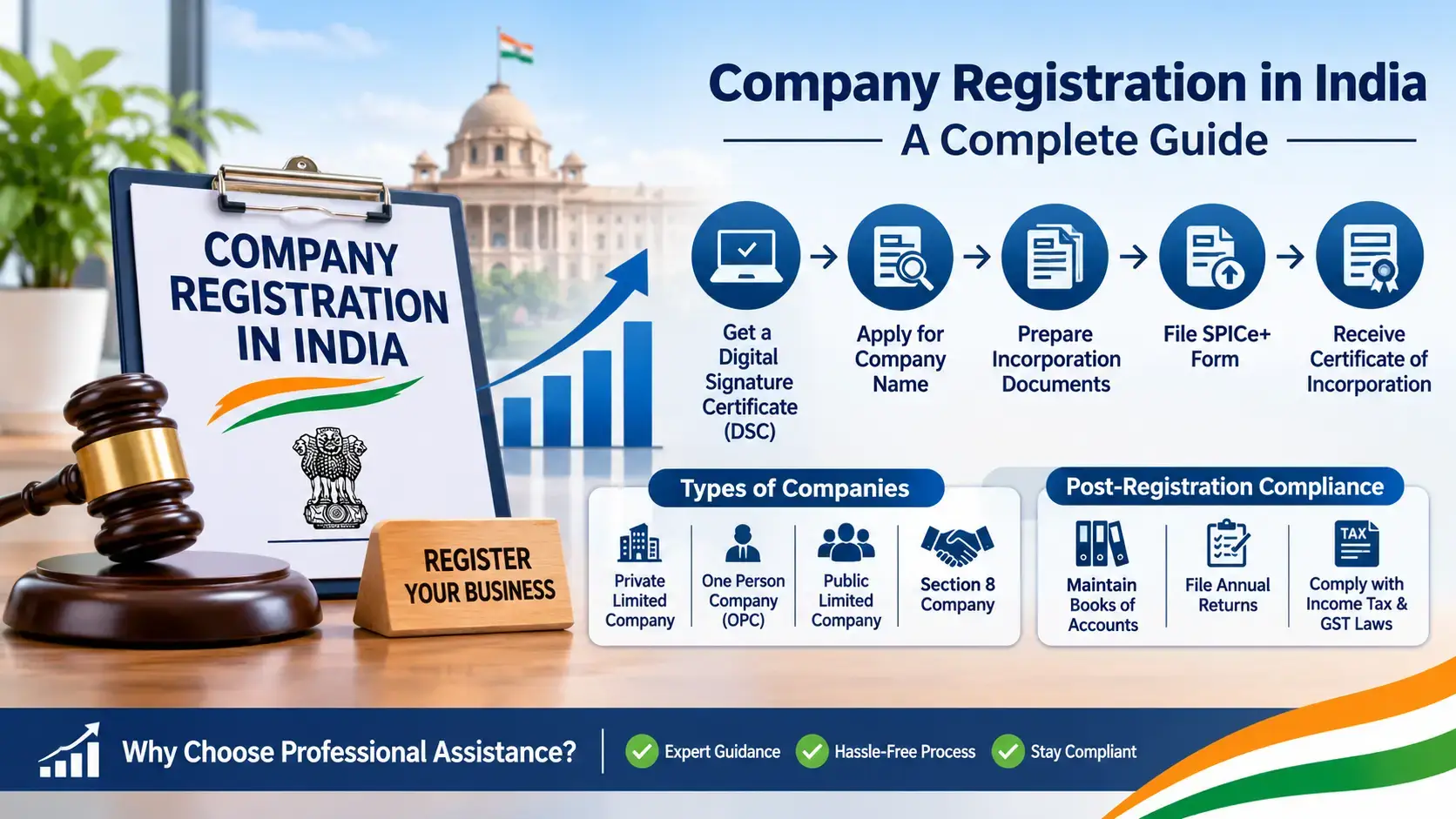
Company Registration in India Types
Entrepreneurs need to decide on the right type of business entity before they start the incorporation process, based on the level of control they want, their business goals and how much they expect the business to grow.
Private Company Limited
A Private Limited Company is one of the most popular types of companies used by start ups and small businesses. A Private Limited Company must have at least two directors, two shareholders and no more than 200 shareholders. The Private Limited Company also allows for limited liability protection for all its shareholders.
One Person Company (OPC)
A One-Person Company (OPC) is a type of business entity that enables an individual entrepreneur to form a company that has its own legal status. This type of organization would be ideal for entrepreneurs who wish to run their businesses on their own terms, but would also like to have the advantage of being organized as a corporation.
Public Limited Company
The public limited company (PLC) is typically used by larger companies that are seeking to generate funds through the sale of stock to the general public. There must be at least three directors and seven shareholders in a PLC.
Section 8 Company
A Section 8 company may be created for the purpose of promoting any of several non-profit activities such as charity, education, social welfare, protection of the environment, and/or other purposes which have been authorized by the Government. Profits generated from the business of the Section 8 company will be used to further the objectives of the company and will not be paid out as dividends to the shareholders.
Documents Required for Company Registration
The preparation of appropriate documentation is vital to complete the company formation process. Document types typically include PAN Cards, ID Proofs, Address Proofs and Photos of Proposed Directors and Shareholders.
The registration of the business requires that the company provides evidence of their business address; this usually includes a current utility invoice, and an NOC (No Objection Certificate) from the owner of the property where the company will operate. Additionally, the company may have to provide a copy of a rental agreement or other proof of ownership.
In addition, the company has to develop a Memorandum of Association (MoA) and Articles of Association (AoA), that will describe the company’s business goals and how it operates internally.
What Is the Company Registration Process in India?
The Ministry of Corporate Affairs offers an online facility for incorporating companies by using the SPICe+ form. This form streamlines the process of registering a company and integrates other related forms.
Obtain a Digital Signature Certificate (DSC)
A digital signature certificate (DSC) will be required for any proposed director or subscriber who wishes to digitally sign the company’s incorporation documents. This certificate is utilized to verify that the documents being filed with the MCA portal are authentic.
Application to Approve Company Name
The applicant has to select a unique company name as per the naming guidelines of MCA. To apply for a company name the applicant will be required to complete Part A of the SPICe+ form. It is essential to keep in mind that the name should not resemble any of the existing company names or registered trademarks.
Prepare Incorporation Documents
After being approved for a company name, the necessary incorporation paperwork will be created. The documents will include the memorandum of association (MoA), articles of association (AoA), details regarding each of your company’s directors, information about each of your company’s shareholders, and your company’s registered address.
File the SPICe+ Incorporation Form
SPICe+ Part B is a tool that allows for the submission of a Company Incorporation Application. In addition to submitting this application, if required, the Integrated Filing Process can facilitate the allotment of Director Identification Number (DIN) and the Application for Permanent Account Number (PAN) and Tax Deduction Account Number (TAN).
Receive the Certificate of Incorporation
After a review and approval of the application, the Registrar of Companies will provide a Certificate of Incorporation and a Corporate Identification Number (CIN). These two items will confirm the company has been registered as a business entity under law.
Post-Registration Compliance Requirements
Incorporating a company is simply the first step in operating a legally compliant business. Following incorporation, companies are required to meet their relevant statutory and financial obligations.
In addition to these, there is also a requirement to keep appropriate books of account, have an independent audit conducted of the accounts of the company, submit to the MCA (Ministry of Corporate Affairs) on an annual basis a report on the status of the company’s compliance with the Companies Act 2013 and other relevant laws, file your financial statements with the MCA, as well as comply with the various provisions of the Income Tax Act 1961 and the Goods & Services Tax Act 2017.
In addition, businesses must apply for GST registration where appropriate based on the applicable laws. Depending upon the type of business activity, other licenses/registrations could be required.
Why Choose Professional Assistance for Company Registration?
While there is an option for companies to be incorporated online through the MCA, choosing the right type of business entity, drafting the required legal paperwork and completing all relevant registration processes will require careful thought.
Entrepreneurs will be assisted by professional services to learn about the requirements of incorporation, create necessary documents, submit SPICe+ forms and determine what other regulatory compliance issues apply to their business after registration.
Grover S & Co. offers expert help for companies to register their business, incorporate their businesses, provide accounting services, tax preparation services, and statutory compliance. If you’re launching a brand new business or want to make your existing business official, we have the know-how to get you through the registration process much faster.
Summary
Company registration in India provides the entrepreneurs a legal entity to operate in an official capacity and a stable platform to build upon as their venture grows.Each step in the registration process calls for careful consideration from the choice of the most appropriate type of business structure and the acquisition of the Certificate of Incorporation to the continuous compliance.
Knowledge of how to register, what documents are required for registration, and what is needed for MCA filing can help make the process of incorporation easier for entrepreneurs and give them a higher level of confidence when starting their own business.