
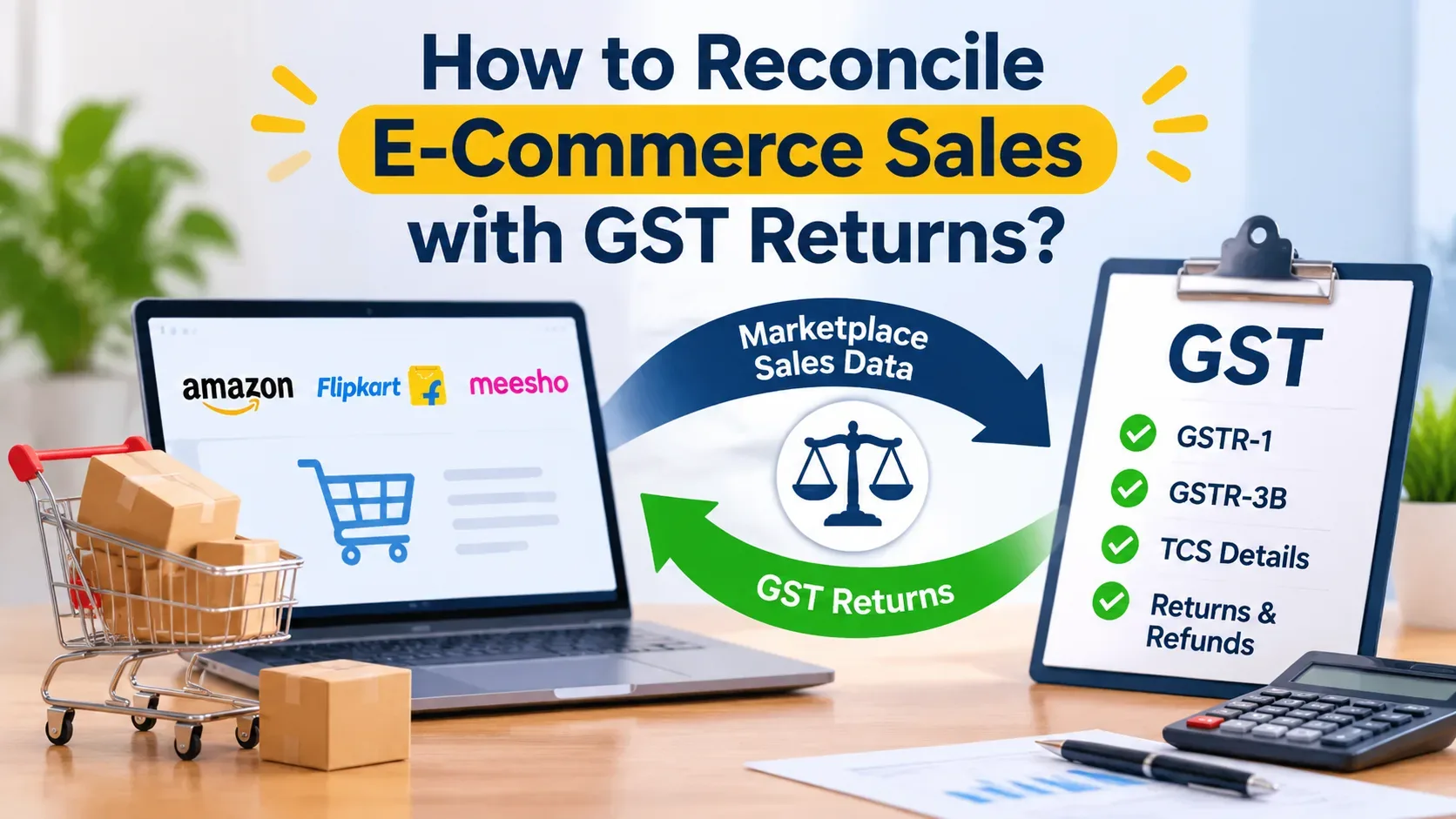
Businesses can use online marketplaces such as Amazon, Flipkart and Meesho to sell their products and reach out to more customers. When selling products through these online marketplaces, businesses need to keep track of all the orders, returned products, canceled orders, marketplace deductions and TCS collected to be GST compliant.
Use the data of your sales on the marketplace to verify what you are reporting to the Indian Government through your GST returns, to get the correct data on your turnover and taxes due. If the data in the marketplace reports does not match your own accounting records and GST returns it can cause confusion and you might need to get more help to find out why. Knowing how to compare the different sets of records will allow you to make sure that your accounting records are correct and you can deal with the requirements of GST easier.
What Is E-Commerce Sales Reconciliation Under GST?
E-commerce sales reconciliation means matching the sales figures reflected on e-commerce sites with the business invoices, accounting records, and GST returns. A comparison like this can help sellers to identify the differences in their taxable sales, GST amounts, returns, refunds and TCS deductions.
Total sales of an online retailer can be around Rs. 5 lakhs over a period of one month. However, after deducting the return goods, commission paid to the platform provider, shipping fees, etc, the settlement amount will be lower than the total sales amount. Note that the settlement amount is not necessarily an indication of actual taxable income.
Businesses can use proper reconciliations to determine the differences among gross sales, taxable supplies and final payments received from markets.
Why Is GST Reconciliation Important for Online Sellers?
Online businesses commonly receive payment for items sold on their platforms only after a number of adjustments have been made to the purchase price by the operator of that platform. Failure to record each adjustment properly will result in discrepancies between the sales figures as reported in the business’s accounting records and the sales figures as reported in the business’s GST returns.
Conducting reconciliations regularly will help businesses find missing invoices, incorrect tax calculations, unaccounted credit notes and any discrepancies in marketplace reporting. Reconciliation is also useful to ascertain whether the information of TCS provided by the e-commerce operator is correct or not as against what was recorded by the seller.
Good record keeping will reduce the likelihood of errors in your reporting and will also assist you in answering questions about GST.
Matching GST Returns with E-Commerce Sales – How to
Marketplace Sales vs Your Sales Register
The first step is to scrape the sales data of interest from e-commerce platforms like Amazon, Flipkart and Meesho. Once you have downloaded these reports, cross reference the order information against the sales invoices located in your accounting software or sales register.
Verify missing or incorrect entries in invoice dates, taxable values, GST rates, tax amounts and places of supply for transactions
Returns, Refunds and Cancelled Orders Review
Returns and cancellations can cause the difference between the sales reports from the marketplace and GST records. Sellers must reconcile return orders with the related credit notes and accounting entries.
Where a sale has been recorded and a credit note is required, the GST implications of that transaction must be considered under the relevant legislation.. It is also important to distinguish between sales orders which have been cancelled prior to the delivery of the goods/services and those which have been completed.
Match GSTR-1 with Marketplace Info
GSTR-1 is a statement containing details of outward supplies made by registered business entities. Separate sections have been provided in GST Portal to report supplies made through e-commerce operators as per Section 52 and Section 9(5) of CGST Act.
Sellers need to confirm the right reporting category, taxable amount and tax rate before completing the form. Also, sellers should examine the marketplace data the seller used to determine if there are discrepancies between that data and the seller’s sales data.
Show GST TCS Information
Section 52 requires e-commerce operators to collect tax at the point of sale (or ‘at source’) on the applicable net taxable supplies taking place through their respective platform.
Sellers are required to match the TCS data in their GST accounts with the reports from the marketplace and correct the details in GSTR-8. Such comparisons will probably reveal differences due to reporting periods, returned supplies and/or inaccuracies in transaction details.
TCS Reconciliation should be done independently of the Actual Output GST Liability of the seller.
Sales compared with GSTR-3B
Businesses need to ensure that they have correctly reported the outward tax liability in GSTR-3B considering sales invoices, returned goods and other relevant adjustments.
The taxable values and tax amounts should be same as the respective transaction data and reporting in GSTR-1. Special attention needs to be paid to the transactions under Section 9(5) as these will require separate reporting and separate payment of taxes.
Common Causes of E-Commerce GST Reconciliation Discrepancies
There may be differences between the information in marketplace reports and what is reported on your GST return. These discrepancies may be due to the delay in updating your orders, customer returned products, input errors in your invoices, reporting on different timelines, missing credit notes, or errors in your tax calculations.
Marketplace commissions and shipping fees can make it difficult for a seller to compare their “net” settlement amounts with their actual “taxable” sales. Sellers will need to look at these two types of fees separately by using the invoice or other accounting records that support each type of fee.
How GSCCA Can Help in E-Commerce GST Reconciliation
Managing marketplace transactions and doing your GST filing can be challenging as your online business grows. You will have to spend time and effort to reconcile your sales data, credit note data, TCS data and relevant GST reporting requirements.
GSCCA offers GST consulting services and compliance services to businesses selling products online or have an e-commerce site. Our services are: – analysing your GST returns – reconciling your sales figures, – verifying your input tax credit details – helping you to file your GST returns.
GST Return Filing Assistance & GST Services for E-Commerce Sellers in India will help you manage your tax compliance obligations.
Conclusions
Reconciling e-commerce sales with the GST returns is one of the most important parts of running an online business in India. Cross checking sales invoices against marketplace reports, checking returns, verifying TCS details and ascertaining the accuracy of the GST return data will ensure that the financial record keeping of the businesses is accurate.
A good process for matching accounts will help to find variances in reports before those variances turn into larger compliance issues. For example, online sellers need to periodically review their GST records and take professional help when they see anything out of the ordinary in transactions that require deeper scrutiny.

One Response